
Choosing to study Sport and Exercise Science (SES) in UL was the best decision I made as it provided me with a foundation to build on and further my studies in the area of Human […]
Choosing to study Sport and Exercise Science (SES) in UL was the best decision I made as it provided me with a foundation to build on and further my studies in the area of Human […]

Women’s Rugby Union is on a continuous rise with an increase of registered female players of 28% since 2017, 2.7 million current female players worldwide and over 25% of the global player population being female. […]
|
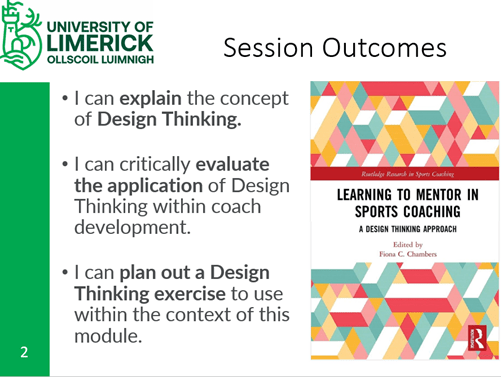
Design Thinking The coaches on the MSc Applied Sports Coaching programme work together to review and develop their coaching. On the Athlete & Coach Development module which runs over the summer of the first year, coaches will visit each other’s sessions and explore the potential of mentoring to accelerate coach development. To aid coaches in structuring this observation and mentoring, we use a concept called Design Thinking.
The acknowledge of mentors is often prominent in the life stories of expert coaches. Mentoring is also a common element in coach development and is something that, when done well, can have a hugely positive impact. However, there’s a little bit of fuzziness, a little bit of uncertainty as to what mentoring involves. On the MSc Applied Sports Coaching, we use Design Thinking as a means by which coaches can have a structure, a scaffold around the mentoring conversations they are engaging in, to help them to get the most benefit from the experience.
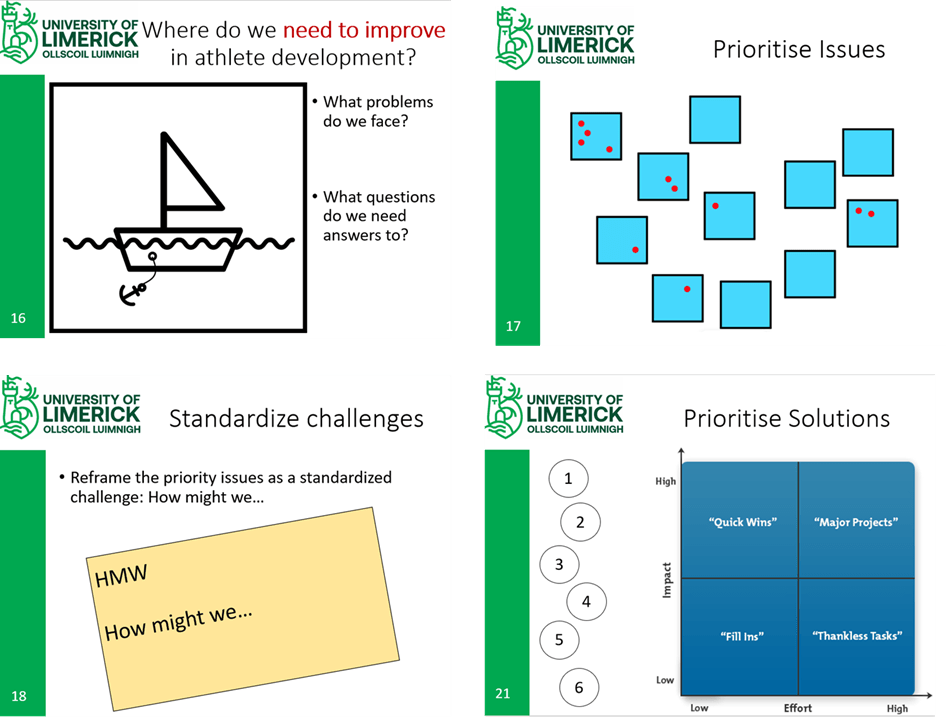
So, what is design thinking? In typical problem solving, we would spend very little time defining the problem. We often jump quickly to one possible solution and we maybe don’t think about other possible solutions. We often don’t think carefully enough about the specific actions that are required to bring a solution to life as much as we could. Design thinking is a series of steps to follow that gives us that structure around the definition of the problem, structure around the development of potential solutions, structure around the specific action plan that we’re going to put together that allows us to be more effective in the mentoring conversations and the mentoring relationships that we have. Where can coach developers learn more about Design Thinking? We use Fiona Chamber’s book Learning to Mentor in Sports Coaching: A Design Thinking Approachv, which contains a range of examples of how the approach can be applied in sports coaching contexts. The student perspective: Louise O’Brien (Gymnastics Coach)   Where can I read more about the programme? What is the deadline for applications? Applications are reviewed on a monthly basis, and places awarded based on the calibre of application until the course is full. The next deadlines are: · June 30th 2023 · July 21st 2023* *subject to places remaining on the programme. If you are interested in the programme or require further information please contact: Tel: 00-353-61202844 |

APPLICATIONS INVITED FOR: Post Doctoral Researcher in Physical Education Teacher Education The purpose of this job is to develop research to improve the educational quality in physical education and physical education teacher education through an […]

Research Impact: The Mental Health of Youth Story (MYSTORY) study is the first known study to explore young people’s perspectives on their voice and involvement in school mental health and suicide prevention. MYSTORY used a […]

Research Impact: Two teacher educators and two practising physical education teachers, worked together to explore the notion of integrated learning experiences and constructed teaching resources for the teaching of such experiences. The research team constructed […]
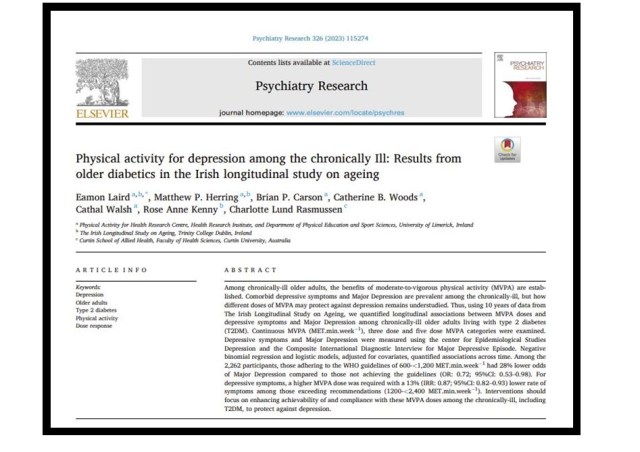
Research Impact: How different doses of MVPA may protect against depression remains understudied, particularly among the chronically-ill. Using 10 years of data from The Irish Longitudinal Study on Ageing, we quantified longitudinal associations between MVPA […]

In June 2022, PESS hosted a delegation from Stellenbosch University (SU), South Africa in the first phase of a collaborative research project focussed on coaching and coach development. This extends the long-established relationship between SU […]
Effective communication is a critical part of a rugby union referee’s performance, yet there is a dearth of literature surrounding this area of rugby union referee development. This is the first study of its kind […]

We are hugely pleased and humbled with the level of interest in the Professional Doctorate in Human Performance and Innovation at UL (4-year, part time). The programme is hugely successful and in high demand. Entry […]
 PESS News & Information