
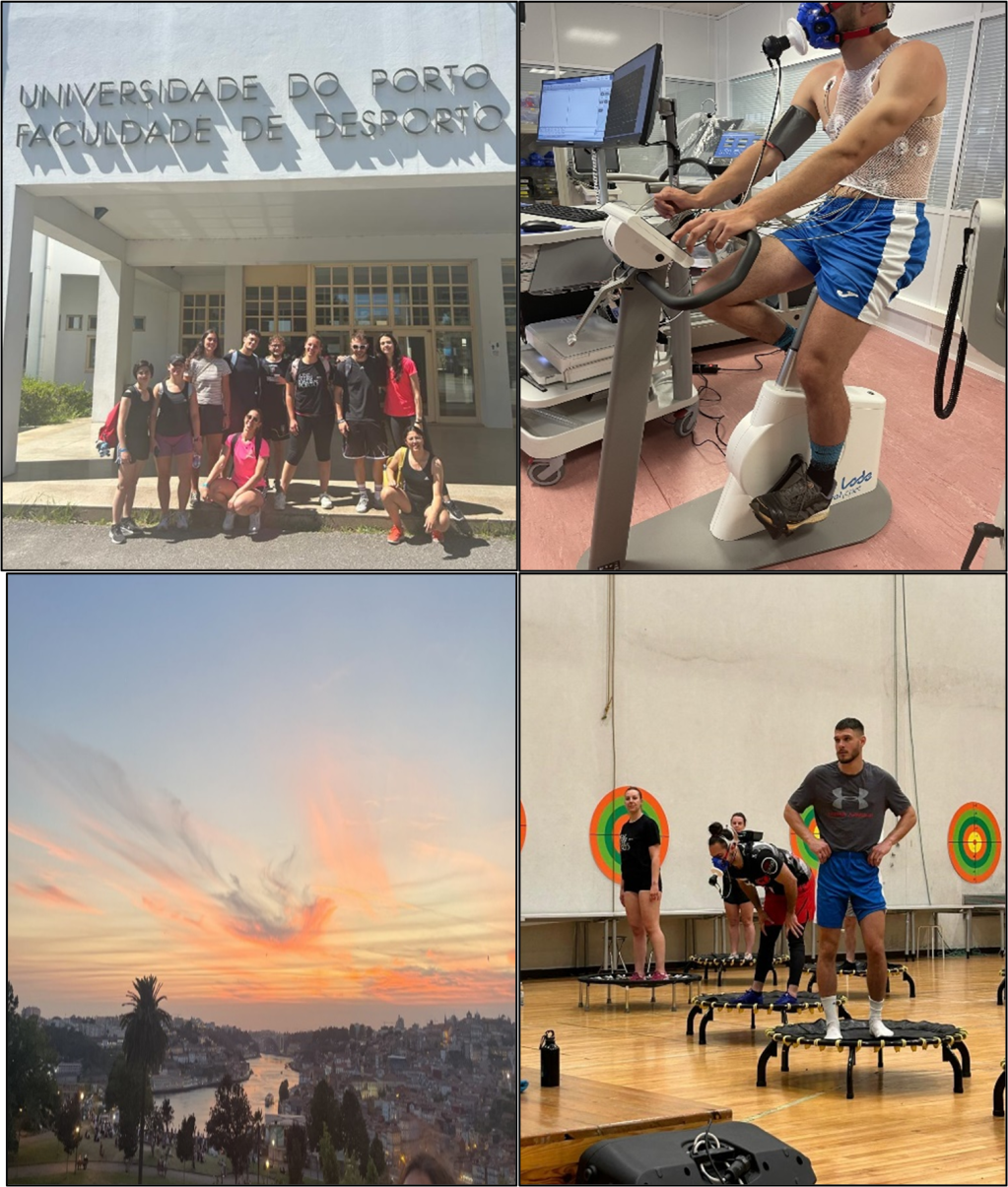
When the email went around advertising an 8- week physical activity blended intensive programme, including two-weeks in person, I thought about what a wonderful opportunity it would be. Upon first glance it appeared only suitable for Undergraduate and Masters students and staff members. So, I quickly moved on to the next email in my inbox and the never ending do list and forgot about it.
Until a couple of days later when a message comes in from DJ Collins (International Coordinator, PESS) ‘Well, do you want to go to Porto for 2 weeks?’. When I finally came to the realisation that not only were PhD students eligible to do it, but it was also worth 3 ECTs that would go towards the structured PhD, I was sold. Well, that and the idea of spending two weeks in a beautiful Portuguese city during the busy summer tourist season.
Before I talk you through the important stuff lets continue that romantic idea of getting to spend two-weeks in Porto. From witnessing traditional Portuguese Fado singing, eating many Pastel de Nata (custard tarts), the old trams, the infamous Sao Joao festivities (St Johns eve) which saw upwards of 2000 people gather around the Douro River hitting people over the head with plastic squeaky hammers and best of all the sunsets that were out of this world.
In addition to the cultural experience, I got to refresh and learn on all thing’s physical activity and physical fitness measurement at FADEUP (Faculty of Sport). At the CIAFEL laboratory we got to perform tests, observe and learn about data processing and analysis for different components of fitness such as, body composition using the DXA (a first-time experience), a portable metabolic system (COSMED K5) and the Cardiopulmonary Exercise Test to capture VO2max. The highlight of these physical fitness measures was observing their practical relevance and applications.
We also observed a PhD student testing the efficacy of a portable isometric testing device on the quadriceps against the gold standard BioDex for use by physiotherapists in the field. All the time trying out new forms of activity such as jump fit, rock climbing, surfing, crossfit, pilates and outdoor adventures.
This opportunity was invaluable, the application process was simple thanks to the UL international office and University of Porto’s Faculty of Sport. If this programme runs again next year, I strongly recommend to any PESS undergraduate or postgraduate students who would like to earn ECT’s during the summer months. I expanded my connections with other PhD students and faculty members from different Universities across Spain, Italy, Slovenia and of course Portugal. Most importantly I expanded my Portuguese vocabulary beyond ‘ola’ and ‘tchau’, but please don’t expect me to hold a conversation!
Caera Grady is a second year PhD student in the Physical Activity for Health research centre. Her research focuses on adolescents physical activity promotion, specifically in secondary school settings.
Contact: Caera.grady@ul.ie @caeragrady2011 Caera Grady

 PESS News & Information