
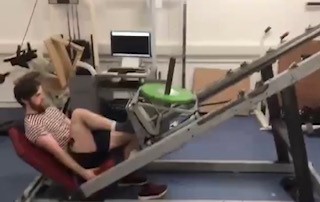
Muscle power is the most age sensitive, i.e., declines more than muscle strength with age, and thus the most functionally relevant measure of neuromuscular performance.However, current older adult resistance training guidelines generally prioritise muscle strengthening exercise for older adults, and when power training guidelines are presented, it is generally for non-ballistic contractions (i.e., load is not thrown). Whereas ballistic contractions, where the intent is to throw the load appear to offer a greater power training stimulus as there is no need to decelerate prior to the end of the lifting phase. However, inevitably this raises the question; how do we safely perform ballistic contractions during a relatively functional task, i.e., leg press? The first step in my PhD journey was to construct a leg press that could perform ballistic contractions safely across the force-velocity spectrum, whilst simultaneously measuring force and velocity during the contractions. We managed to develop this bespoke leg press over a 6-month period, using multiple, moveable one-way catches to enable the load to be thrown. The working leg press can be found here: Emmet Mc Dermott on Instagram: “Another week of testing completed measuring kinetics, kinematics and neuromuscular activation during ballistic contractions 💪 😁 #Research #DontTryThisAtHome” Once we had a working leg press, the next step was to investigate the neuromechanics of ballistic and non-ballistic concentric contractions using different resistance training loads. Unsurprisingly the ballistic contractions produced greater power output than the non-ballistic alternatives, but there was a fairly pronounced effect from a 1 to 11-fold enhancement in power performance across the loading conditions, primarily due to the higher velocities during ballistic vs. non-ballistic contractions. Therefore, ballistic contractions may offer a more potent power training stimulus. However, whether the acute enhancements in power performance with ballistic contractions actually elicits greater improvements in muscle power performance following a training intervention vs more commonly prescribed non-ballistic contractions is currently being explored. The full journal article can be found here: Fast and ballistic contractions involve greater neuromuscular power production in older adults during resistance exercise | European Journal of Applied Physiology (springer.com) A second study in my PhD was interested in the inclusion of a prior eccentric lowering phase immediately prior to the concentric lifting phase on power performance. The phenomenon of the stretch shortening cycle is well established, but when the effect of a prior eccentric lowering phase on concentric neuromechanics has been investigated in humans there has often been the confounding influence of the speed at which people perform the prior eccentric phase varying (more slowly or faster) depending on the load lifted. In this current study we had participants perform the prior eccentric lowering phase over a fixed time period for all training loads. It was found that performing a prior eccentric phase augmented mean power performance (+15 to 55%), but not peak power performance when compared to concentric contractions performed from rest. Interestingly, differences in mean power performance appeared to be related to the load lifted with the magnitude of the difference in mean power performance becoming progressively greater at higher resistance training loads. The power enhancement at higher resistance training loads following a prior eccentric lowering phase was due to elevated contraction velocities as a result of progressively greater forces at the onset of concentric lifting phase as the resistance training loads increased ultimately leading to greater initial acceleration following a prior eccentric phase. The journal article can be found here: The effect of a prior eccentric lowering phase on concentric neuromechanics during multiple joint resistance exercise in older adults – Mc Dermott – 2023 – Scandinavian Journal of Medicine & Science in Sports – Wiley Online Library In summary, ballistic contractions where the resistance training load is thrown may offer a more potent power training stimulus than conventionally prescribed non-ballistic contractions, with potential to further augment power performance particularly at heavier resistance training loads with the inclusion of a prior eccentric lowering phase immediately before the concentric lift. However, further research is needed to understand the long-term adaptations, i.e., power performance, performance of activities of daily living, muscle activation, and muscle size. Furthermore, the perceived tolerability and adherence to ballistic training in older adults remains to be explored. |
Dr. Emmet Mc Dermott, is a Teaching Assistant in Sport and Exercise Science, in the Department of Physical Education and Sport Sciences, UL. Emmet initially attended the Institute of Technology Carlow, where in 2016 he graduated with a BSc in Sport Science. In 2017, Emmet graduated with MSc in Exercise Physiology from Loughborough University and remained in Loughborough to complete his PhD in Neuromuscular Function under the guidance of Prof Jonathan Folland, graduating in 2022. Emmet has previously held roles as an assistant lecturer role in Sport Science at the South-East Technological University, and lecturer in Sports Engineering at Nottingham Trent University.
Contact: emmet.mcdermott@ul.ie.

 PESS News & Information