

Thank you to Pau Kinnerk for a really insightful presentation on planning for sports coaching. The enthusiasm for the subject was infectious and the level of detail behind the planning superb.
In this blog, I will comment on a few items and resources from the workshop, and from the broader day, that resonated with me.
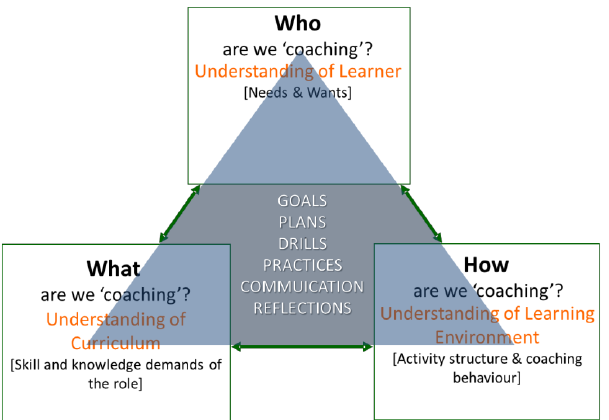
Paul referenced a model that we have already met on the Coaching Process and Practice module which is detailed in an excellent chapter by Andy Abraham and colleagues. The most effective planning requires extensive detail on Who you are coaching, What you are coaching and How you are coaching. Paul challenged us to consider whether, without knowing that detail in all three areas, are your sessions going to carry as much meaning as they might for the athletes you are working with? Are you going to be able to devise the most purposeful practice? How strong would you rate your knowledge of Who, What and How?
Another takeaway for me related to Paul’s emphasis on a place for “dialogue moments” – often coach-player huddles, but also player huddles, freeze in position reviews, and individual conversations with players at different points. While these dialogue moments contribute to learning in the moment, they also have a longer term purpose of helping to get everyone on the same page, seeing the same opportunities, speaking the same language. Especially in training environments where the emphasis is on maximising time at high intensity, facilitating quality dialogue in 2 minutes or less is a considerable skill, but when done well can bring about short term and longer term gains.
A final takeaway related to a topic we are currently researching: session sequencing. Our previous research on Gaelic Games coaches suggests that sequencing may be a tool that coaches could make more of. Paul encouraged us to reflect on the session sequences we are and could be using.
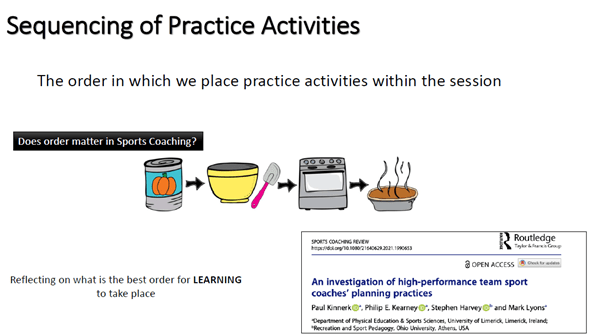
To find out more about Paul’s research on planning, see: https://www.tandfonline.com/doi/full/10.1080/21640629.2021.1990653
While Paul’s guest lecture was the centre piece of the day, we began with a session where coaches shared their plans for their performance analysis assignments: examining how they collect, analyse and communicate data within their contexts with a view towards enhancing their practice. We are back online next week, examining what lessons the research holds on how to communicate performance analysis data most effectively.
The day finished with a session examining the characteristics of high-quality reflective practice, in terms of the content and process of reflection. Coaches shared an example reflection leading to a wide-ranging group discussion. When done well, reflection is a powerful tool to advance coach learning. Taking the time to really explore the content and process of reflection is vital to developing coaches who exploit reflection to its fullest and leave no lessons behind.
Where can I read more about the programme?
Applications are open for September 2024. You can read more about the programme here, or take a look at #MScAppliedSportsCoachingUL where you will find insights such as exemplar pre-course activities and examples of the type of research we will be engaging with. You can also explore these FAQs.
If you are interested in the programme or require further information please contact:
Dr. Philip Kearney PhD
Course Director – MSc Applied Sports Coaching
Department of Physical Education and Sport Sciences
University of Limerick
Limerick.
Ireland
Tel: 00-353-61202844
Email: ASC@ul.ie
Dr. Phil Kearney is a Lecturer in Motor Skill Acquisition Coaching and Performance and Course Director in MSc. Applied Sports Coaching in the Department of Physical Education and Sport Sciences at the University of Limerick. Dr. Kearney’s current research interests include maturation and youth sport, coaches’ knowledge and practices and enhancing practice quality. You can contact Dr. Kearney via email at philip.kearney@ul.ie or view his research profile on ResearchGate
 PESS News & Information