

In this blog, I will discuss the prospects of combining policy and research in physical education, physical activity and youth sport.In my literature review, I explored the spheres of policy and research along with its relationship with physical education, physical activity and youth sport in the Irish landscape. From an initial scoping, both policy and research in the Irish context are saturated realms; creating a complex, crowded and diverse space. Policy and research are often seen as two distinct separate areas with little interconnection, but the question I am posing for this blog is what happens when these two areas combine and work in tandem? Policy is a framework; it shapes the world in which we live with the objective to improve public life (Althaus et al., 2022). Examples of policy specific to my research include the National Physical Activity Plan for Ireland, the National Sports Policy 2018 to 2027, and primary school and second level physical education curricula to name but a few. Such policies are enacted through practice, with Sallis et al. (2009) deeming policy intervention as one of the most effective and promising strategies for population-wide change in physical activity behaviours. While research advances knowledge, researchers carry out investigations and analysis’ that identify problems, discovers patterns, and proposes solutions (Thomas et al., 2015); it supplies the evidence by which policies should be informed (Lingard, 2013). By working in tandem, research can inform and support policy. A powerful, dynamic duo can occur, one which can trigger meaningful change and contribute to solving societal challenges over a period of time. The dilemma relative to this research context is achieving national and global physical activity targets to increase healthy physical activity behaviours, and enhance the health and well-being of the population. In the education field especially, the connectivity between research and policy suggests research should have an enhancing contribution to policy-making (Lingard, 2013). Two important concepts are research for policy and research of policy. Research for policy, is research commissioned by policy makers with a direct and immediate purpose to assist in policy production. Research of policy is more academic and long-term as it, “seeks to deconstruct the problem as constructed by policy” (Lingard, 2013, p.127), interpreting and dismantling what is often taken for granted in the contemporary world. It is argued that research is commonly catalysed in the policy process to validate previously decided policy actions. Research of policy is often advocated for, due to its potential to make more profound effects on policy and the policy-making process. In short, policy without research runs the risk of becoming formed through ideologies and opinions rather than evidence. Similarly, research commissioned without use for policy may result in evidence that is purely academic without translating into any tangible improvement in society. The combination of policy and research is a crucial problem-solving mechanism, attempting to create pragmatic courses of action to ameliorate problems presented in the physical education, physical activity and youth sport fields. A productive collaboration between policy and research holds immense potential to drive change nationally and internationally. A positive relationship fosters more effective, influential, evidence-based policies which can address societies’ needs to improve public life. References · Althaus, C., Ball, S., Bridgman, P., Davis, G. & Threlfall, D. 2022. The Australian policy handbook: A practical guide to the policymaking process, Taylor & Francis. · Landi, D., Walton-Fisetter, J. L & Sutherland, S. 2021. Physical education policy research in the United States: Setting a new orientation. Quest, 73, 45-62. · Lingard, B. 2013. The impact of research on education policy in an era of evidence-based policy. Critical Studies in Education, 54, 113-131. · Sallis, J. F., Story, M. & Lou, D. 2009. Study designs and analytic strategies for environmental and policy research on obesity, physical activity, and diet: recommendations from a meeting of experts. American journal of preventive medicine, 36, S72-S77. · Thomas, J. R., Nelson, J. K. & Silverman, S. J. 2015. Research Methods in Physical Activity. |
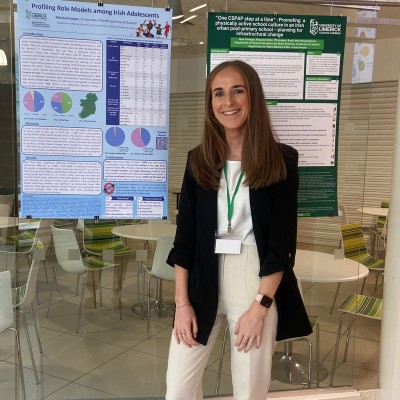
Mairéad Grogan is a postgraduate student in the Department of Physical Education and Sport Sciences, UL.
Contact: Email mairead.grogan@ul.ie @grogan_mairead LinkedIn
 PESS News & Information