
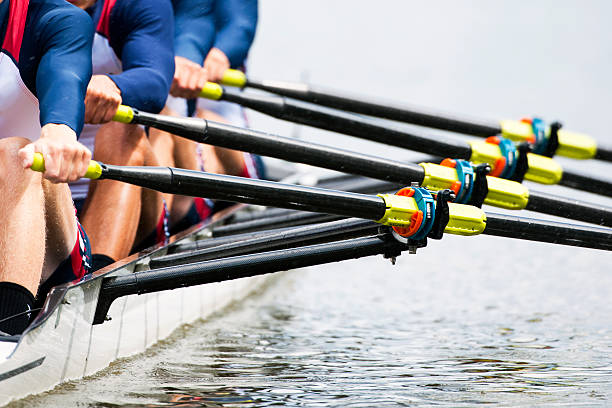
You may have noticed the wires taped on to the boat riggers of clubs like Cambridge or Oxford Brookes during training videos this season or strange looking oarlocks as you walk around the boat yard at a recent race. These are all examples of telemetry systems, and they are a hot topic in rowing at the minute. Telemetry allows you to measure numerous metrics in a rowing boat such as the oar angle, force curve, stroke length, power, acceleration, and blade slip. These metrics were previously very difficult to measure during on-water rowing. They help to quantify the observations of a coach and enable instantaneous technical and physical feedback to a rower. Modern society is increasingly becoming more data driven and it is no surprise that coaches and rowers want to be more informed when making decisions on performance improvements, technical changes, race profiles, equipment, crew lineups and even crew selection.
Telemetry is not a new thing and has been around for quite some time (Warmenhoven et al., 2018) but advancements in technology have helped to make telemetry systems smaller, simpler, and cheaper which has greatly increased their use across the rowing community. There are numerous systems available on the market and some of the more popular are the Peach PowerLine, BioRow, and Nielsen-Kellerman EmPower Oarlock systems. When considering what system to purchase it is important to consider their accuracy. A recent study by Holt (2021) found that the Peach PowerLine system is more accurate when measuring the catch, finish, and oar arc angles in comparison to the Nielsen-Kellerman EmPower Oarlock. Another study by Holt et al., (2021) found that the Peach PowerLine system is more accurate when measuring power in comparison to the Nielsen-Kellerman EmPower Oarlock. However, to the best of the author’s knowledge there is currently no peer reviewed published data that compares the accuracy of the BioRow system to a gold standard reference system.
So how is telemetry helpful for coaches and rowers?
- Instantaneous on-water feedback to the rower.
Telemetry enables rowers to be provided with instantaneous on-water technical and physical metrics (e.g., oar angle, force curve, stroke length, power, etc.) via a screen that is fixed to the boat. A study by George (2013) on 8 rowers from the Canadian women’s under 23 team found that catch angles improved by 8% when the Peach PowerLine system was used to provide instantaneous oar angle feedback compared to visual and verbal feedback. Similarly, training zone adherence has been shown to improve by 65% in well-trained rowers when instantaneous power output feedback was provided during training (Lintmeijer et al., 2019).
- Selecting sweep rowing crews
Symmetrical force application between bow and stroke sides in sweep rowing has been suggested as necessary to minimise drag forces arising from boat yaw (i.e. stroke side pulling bowside around or vice versa), with differences in synchronicity between crew members suggested to be more detrimental to performance than differences in force curve area (Wing and Woodburn, 1995). However, differences in force curve synchronicity prove beneficial in coxless pair boat classes where an earlier and higher peak stroke force in stroke seat compared to that of the bow seat minimises boat yaw while the bow seat applied a greater force than the stroke seat leading into the finish (Smith and Loschner, 2002). This is due to the asymmetrically rigged nature of the pair where force is applied at different positions relative to the boat’s centre of rotation, resulting in differing rotational force moments acting on the boat from each rower (Coker, 2010).
- Selecting sculling crews
Seating order in crew sculling boats is another important consideration but less is known about this currently. A study on double sculls by Coker (2010) involving 4 elite male scullers (medallists at the World Cup or World U23 Championships) suggests that an earlier peak stroke force achieved by the stroke seat sculler in comparison to that by the bow seat is recommended to achieve a rectangular shaped crew average force profile, corresponding to a more even force application, and subsequently minimised within-stroke boat velocity fluctuations. Therefore, symmetrical force application may not be as important as was first believed for sculling boats which are more symmetrical in nature than sweep boats. Coker (2010) also found that stroke force and peak stroke force appear to decrease between single scull and quadruple scull boat classes. This can be explained by the force-velocity relationship which states that as the speed of muscle contraction increases, the force that can be generated by the muscle decreases (Hamilton and Luttgens, 2002). Larger and faster boat classes require a greater speed of muscle contraction but less force production and this should be considered by coaches during gym-based profiling of force producing capacity at different speeds as it may help with identifying who is better suited to different boat classes or seats (Coker 2010).
There are numerous other applications of telemetry in rowing, and this blog only really covers a brief introduction. For further information on this topic, have a look at this excellent video by Conny Draper.
Dr Frank Nugent is the Endurance Sports Science Theme Lead at the Sport and Human Performance Research Center and Course Director of the BSc in Exercise and Health Fitness Management in the Department of Physical Education and Sport Sciences, UL. He has a PhD in Performance Physiology and is an accredited S&C coach through the Sport Ireland Institute and UK Strength and Conditioning Association.
Contact: frank.nugent@ul.ie Researchgate, LinkedIn @FrankNugent10

 PESS News & Information