
Monday, 28th of October
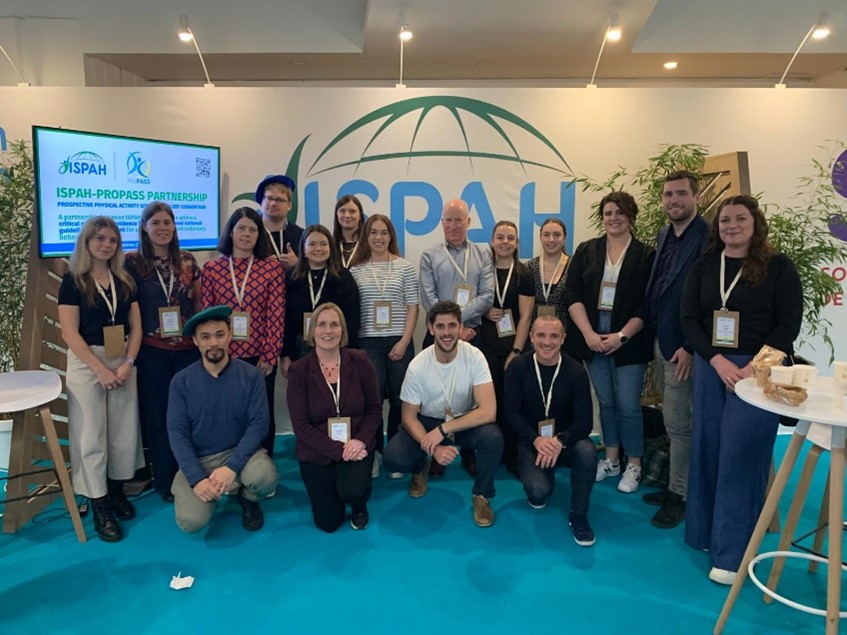
Pre-conference workshops. At our workshop, presentations on our project book-end interactive sessions designed to familiarise participants with the policy tool we have developed (the Physical Activity Environment Policy Index, PA-EPI). The first session familiarised participants with the policy indicators that form the tool and a second familiarised them with processes for using the indicators to perform a policy assessment. It’s a lot of information to throw at people. Six tables worked on the interactive parts of the workshop each with table hosts from the project team. It was interesting to see the differences of opinion on which of the policy indicators were most important and which policies were best implemented. Acting as table hosts raises questions about the extent to which hosts should answer clarifying questions from participants or let participants work through things themselves. As we will use the PA-EPI in 6 EU countries in a recently started project (IMPAQT, see link), this workshop was also a good learning experience for the project team with regards to communicating about the policy tool and how to use it.

Social
Unable to get into the conference reception some of us made our way to an Irish bar. Over drinks we learned about the drivability index being developed by researchers in the Netherlands. Preliminary results seem to indicate that the drivability of a neighbourhood is a good predictor of the incidence of diabetes. A fascinating study of the power of environments to determine health. A large event, the Ballon d’Or presentation ceremony, caused roads to be closed and buses to be rerouted, leading to problems for us getting home in the evening.

Tuesday, 29th of October
The conference officially opened with violins. The first keynote focused on using sport mega events (and specifically, the 2024 Olympic and Paralympic games in Paris) to promote physical activity. However, we will not know whether a meaningful physical activity legacy has been secured for some time. Since the evaluation is incomplete, the keynote could only show good intentions but lacked a satisfying and scientific meaningful conclusion.
The lack of a conference app made self-organising a challenge. Unless a team member is presenting our plan was to go to the presentations and symposia which deal with policy and/or inequalities. The afternoon provided the opportunity to go to a policy symposium. Researchers from the Global Observatory for Physical Activity (GoPA!) described how covid-era increases in active travel have not been sustained. The most memorable analogy of the session is from the Antipodean researcher who encouraged the community to behave less like Owl Monkeys (a famously monogamous primate) and more like the promiscuous Bonobos in our relationship with policymakers from different sectors of government.

Social
Networking opportunities present themselves in the evening. Sven visited a side event on physical activity promotion for children and adolescents; a good opportunity to network with conference attendees from the World Health Organisation, NGOs, and academia. An interesting learning was that French local level representatives critized the ’30 minutes of exercise per day in primary schools’ policy – a key element of the physical activity legacy of the Olympic Games – due to weak policy implementation. What a contrast to the keynote in the morning!
At the same time, Kevin joined an event for early career researchers organised at a local restaurant. He meet researchers from Kuwait and India speaking to the global reach of the ISPAH conference. Kevin goes off too work on his presentation.
Wednesday, 30th of October
The morning keynote contained a very interesting reflection on Lukes’ three dimensions of power, a theory that states that power is exercised in three ways: decision-making power, non-decision-making power, and ideological power. There were many useful examples of how ideology is revealed in the unquestioned privileging of the needs of motorists over the needs of people engaged in active travel. In addition, the keynote speaker raised the question whether physical activity can be seen as a human right.
In the afternoon it’s showtime for Kevin and Sven as their short oral presentations are on. Kevin faced the challenge of having only a three-minute timeslot for presenting the IMPAQT project – a 1.68 million project with 7 work packages connecting partners from 6 EU countries. Sven had an easier task, as he had the same amount of time to present results from a single study. While Kevin focused on the assessment of national level policies, Sven raised the question if and how local policies can be monitored at a large scale, e.g. in a whole country or region.
Social
Again, there is a conference social event that we could have signed up for. Unlike reception this conference dinner costs €115 to attend so we’re less concerned about missing it. We met with Dutch and German colleagues instead and introduce them to the sports of hurling and rugby. Again, Kevin leaves to work on a presentation. Conference week is busy.
Thursday, 31st of October
The morning keynote discusses the policy to practice implementation gap. It’s interesting to hear one of the speakers allege that it doesn’t exist. The Global Observatory for Healthy and Sustainable cities symposium reveals that Limerick is not currently participating in their 1000 cities challenge, an initiative which supports cities to gather data on a series of spatial and policy indicators which can support evidence based urban design. This needs to change!
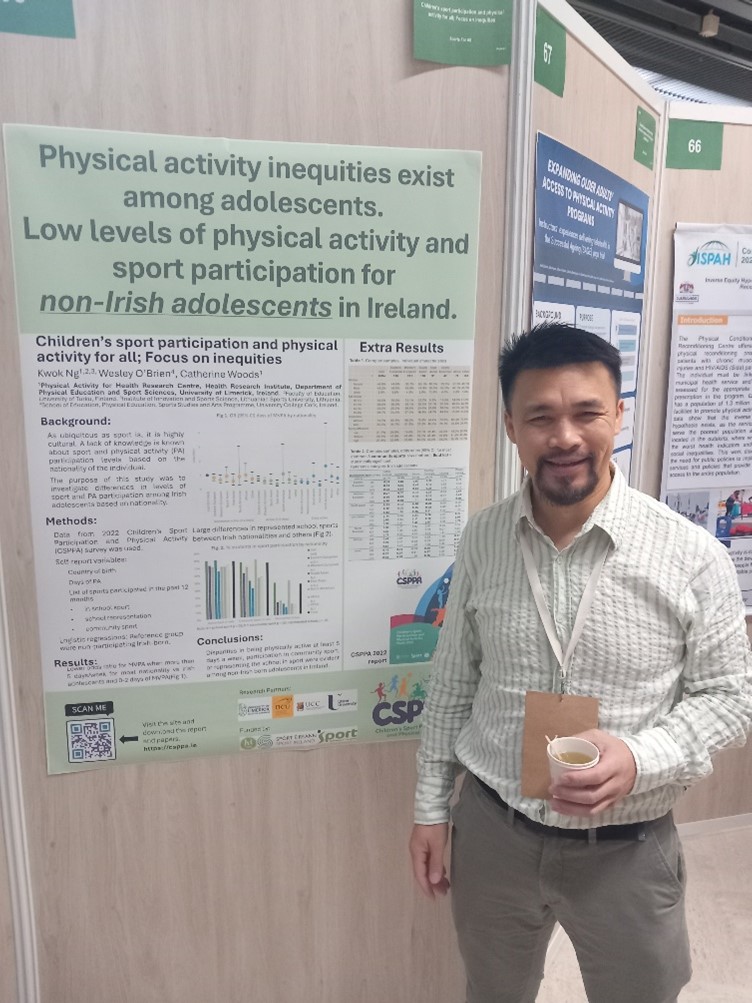
Final opportunity to look at posters is provided before the final sessions and closing ceremony.
Social
The UL research team go out together to Montmartre. We take a picture outside the Moulin Rouge. Expenses won’t cover the €200 entry fee. A trip to the Sacré-Cœur Basilica involves no cabaret either. Over the next few days, physical activity researchers will retreat back to the places from which they came.


Kevin Volf is a postdoctoral researcher in the Department of Physical Education and Sport Sciences, University of Limerick. He is presently working on the IMPAQT project which examines physical activity policy related inequalities across Europe.
Contact Kevin: kevin.volf@ul.ie. Follow on X: @kevin_volf ResearchGate ORCID LinkedIn

Dr. Sven Messing is a Marie Curie Research Fellow at the Physical Activity for Health Research Centre, Health Research Institute, Department of Physical Education and Sport Sciences, University of Limerick. His work focuses on monitoring physical activity policies at different levels of government.
Contact: sven.messing@ul.ie. Follow on X: @SvenMessing. Research Profiles: Researchgate, ORCID, Linked-In

 PESS News & Information