
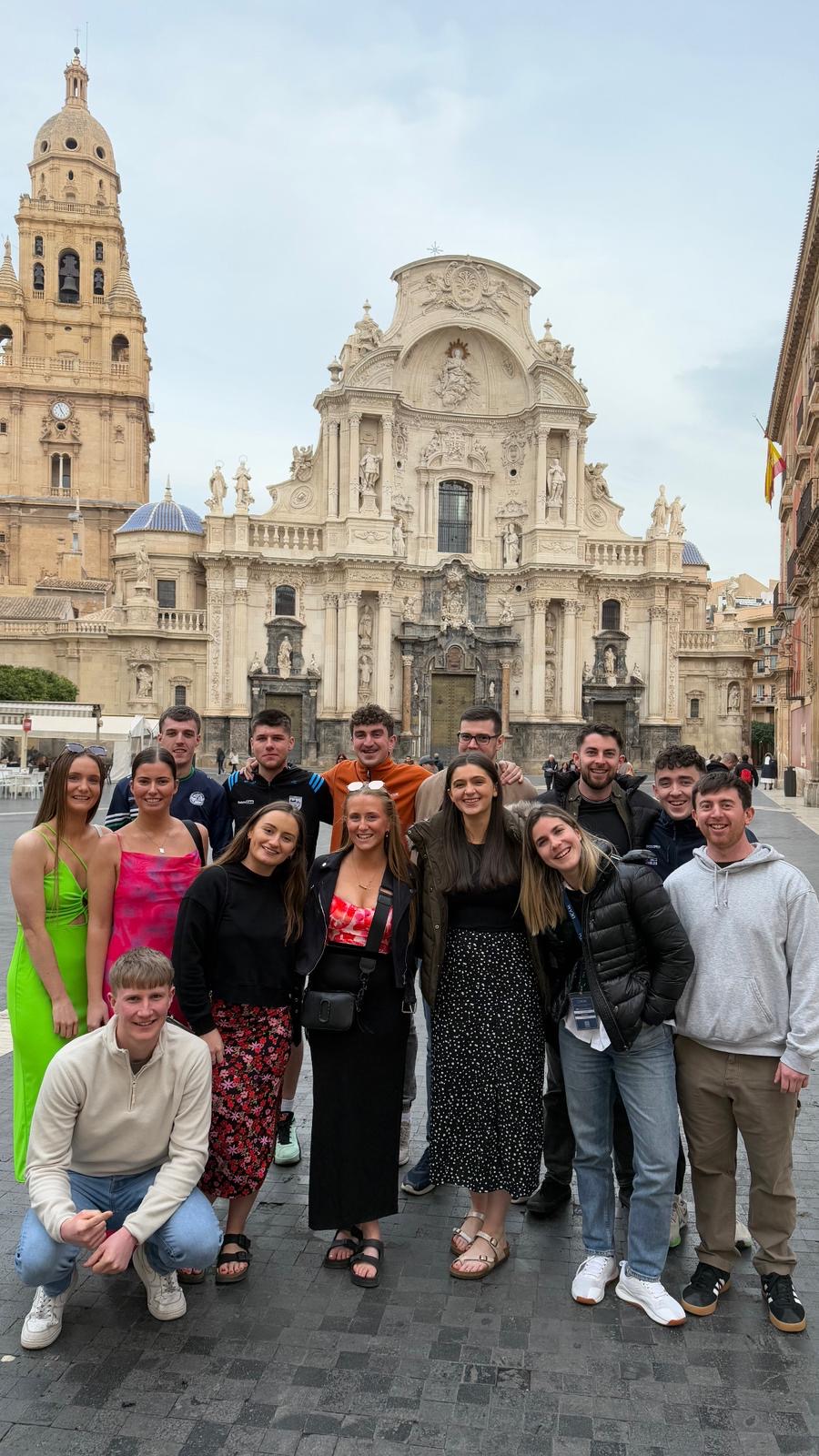
The bespoke sandstone columns of the St Jéronimo’s Monastery are the main protagonists of the UCAM skyline. The whole campus is orientated around its protruding footprint which gives the University a whole different complexion to the familiarities of UL. Thus, it provided a basis of opportunity to emerge ourselves in a different cultural environment.
The Blended Intensive Programme offered an opportunity to experience different Physical Education pedagogical models taught throughout Europe. The programme was a collaboration between three Universities: Universidad Católica San Antonio (UCAM), University of Rome (Foro Italico) and University of Limerick. UCAM was chosen as the host university for the programme where the Sport Science Faculty is highly regarded both domestically and internationally. With its CAR Regional Centre assisting a plethora of Spanish Olympic hopefuls, sport and high performance are a main concentration. UCAM had some very fashionable facilities at its disposal. The exercise centre boasted an expansive gym, rooms for yoga or pilates as well as offering in-house physiotherapy. Meanwhile, the Hi-Tech building which was the scene of one of our lecture sessions, was like something extracted from Space Odyssey. Unlike UL, many sport hubs are located externally to UCAM’s principal campus. You can’t run from your 5pm lecture to catch the football team while the basketball teams shoot their hoops off-campus.
Another contrast, perhaps more immediate, is the third-level pathway students take for Physical Education in other European countries. The bachelor degrees of our Spanish and Italian colleagues on the programme centre on elements of Sports Science rather than PE. The pathway for them to become a PE teacher is to complete a masters after graduating from their bachelor degree. Thus, we held a slight advantage when it came to using pedagogical content (It wasn’t a contest!). The options for our colleagues seemed more diverse whereas here in Ireland degrees tend to be channelled towards one discipline.
The purpose of the week-long programme was to experience different pedagogical models used in curriculums throughout Europe. The teaching sessions for these models were staggered throughout the five in-person contact days with each segment typically consisting of a theory lecture and a practical session. The first session of the week was delivered by the Italian professor Paola Sbriccoli from Foro Italico. She lectured on the IKONS Methodology which focused on a new perspective in decreasing sedentary lifestyle and promoting participation and self-confidence for people with Down Syndrome. This was presented through the medium of “inclusive karate”. The aims of the IKONS project/methodology are to promote and enhance social inclusion, improve physical literacy and inform coaches in participating countries through the approach of adapted karate. The method involves teaching motor skills through colours, pictograms and shapes. An example of this is a student standing on a multicoloured mat and asking them to move their right arm into the blue section creating a ‘striking’ motion seen in karate. Students will find it easier to comprehend instructions through these visual aides.
The second session on Tuesday was very familiar for us UL scholars as it centred on Teaching Games for Understanding and Sport Education. The content was expertly delivered as always by Elaine, Carmen and Antonio who all looked comfortable in UCAM’s HiTech interactive classroom.
The third session or ‘block’ as it was referred to throughout the programme was Cooperative learning and Adventure Education. This session was conducted off-site in the CAR Region’s High Performance centre. Located on the beaches of a lagoon, it was an ideal setting for the purpose of the Adventure Education model. The practical element was taught through paddle-boarding. This was an active and enjoyable session and despite some early wobbles, everyone quickly became comfortable with the balancing dynamics. The instructor emphasised the philosophy of translating skills learned in the PE setting to a wider context. While he did get deep with his analogies, it offered a new perspective on how key learnings from the classroom can be used externally.
The week concluded with us designing and delivering lessons in the local San Agustin school. We taught our lessons in groups while following the key learnings and teaching styles of our chosen pedagogical model. From my own experience of the teaching episode I felt that the language barrier required extra thought to be placed into lesson delivery and instruction. However, the language barrier didn’t impede student engagement as class participation was excellent. I also observed that the physical literacy of these students was remarkable. The skill range wasn’t steep while the class group in general were at a high level in terms of skill development.
Overall, it was an excellent opportunity to experience another University and practice our studied discipline while immersing ourselves in a new culture. On behalf of the group I’d like to express gratitude to Carmen, Ursula, Elaine and Antonio for their role in facilitating this really insightful and enjoyable programme. Saludos a Murcia!
Cormac Thompson is a second year BSc in Physical Education student in the Department of Physical Education & Sport Sciences, UL.
 PESS News & Information