

On the RTÉ coverage of the European Indoor Athletics Championships, Rob Heffernan spoke about the value for young athletes in training for and competing in running jumping and throwing events. Such a multi-event approach is thought to develop well-rounded athletes first who can then specialise in a particular discipline, if they wish, later in their development. But is this true? What does the research say about the value of multi-event participation for young athletes? Research from the Athletics Science theme of the Sport & Human Performance Research Centre has explored this question. As ever in sport science, this seemingly straightforward question becomes a little bit more complex when you start to consider all of variables involved.
In 2021, I led a team which published a paper looking at how common multi-event participation was in youth athletics and the consequences of either specialising or continue to compete in multiple disciplines at both under 13 and under 15. The data we looked at came from a large data set of UK Athletics results. Our first key finding was that specialising in a single event was actually rare at under 13. However, while many athletes competed in two or three disciplines, completing in all four disciplines was also something that not many athletes did. Here’s an updated figure from a subsequent larger scale analysis of data reinforcing our original findings.
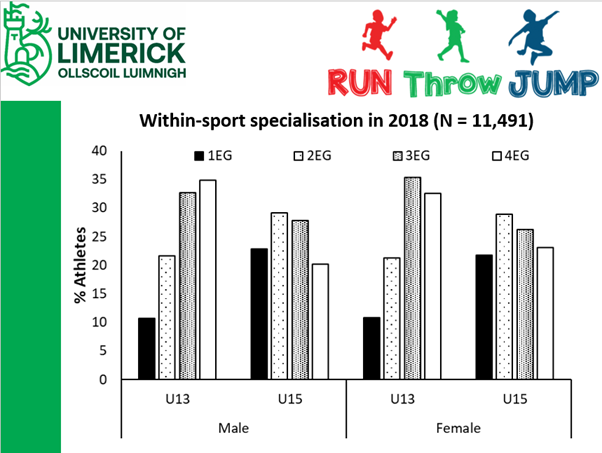
Figure 1. The prevalence of within sport specialisation (1 event group) and multi-discipline participation in youth sport
To investigate the consequences of specialising or competing in multiple events, we looked at top ranked under 20 athletes. We examined what events they participated in at age 12 compared to their peers at U13 who did not progress to be top ranked U20 athletes. For males, there was no relationship between how many disciplines they competed in at U13 and later achieving a top ranking at U20. For females, we did see a relationship: top ranked female athletes in the U20 category were more likely to have participated in multiple events at age 12 then their peers at age 12 who did not go on to become top ranked U20 athletes.
So there is a hint that participating in multiple events may enhance performance, but it’s not a clear result. What is going on here? One likely part of the answer was expressed really nicely by a participant in another study where we looked at coaches’ and parents’ views about the development of athletes. The coach emphasised that when thinking about an athlete’s sporting diet, it is important not just to think about the sport of athletics but all of the sports that an athlete participates in:
“it doesn’t mean they must do different kinds of athletics such as jumps and throws as well as running if they like running. Kids can do other sports BESIDES [emphasis respondent’s] athletics such as cycling, swimming, rugby. So they shouldn’t be forced into doing hurdles and jumps if they don’t want to do it just to please the multi event enthusiasts whose horizons don’t extend beyond the athletics arena” (Participant 34; coach)
So if a young athlete who participates predominantly in throwing events also plays Gaelic football, then their sporting diet includes sufficient endurance running from football and they may not need to engage in endurance running within track and field.
A second limitation of our analysis is that we were only working on competition data. It is possible that individuals who were only competing in a single event were actually training for multiple different events and were gaining the benefits of run jump and throw through their training sessions. After all, jumping forms an important part of the training of throwers and sprinters while throwing medicine balls can be an important part of the training of sprinters and jumpers. As such, participating in multiple athletic disciplines is a great way to familiarise young athletes with a variety of skills that will potentially underpin their training in future years.
So what is the take-home message; should young athletes be encouraged to train and compete in run jump and throw? In general, good advice when designing training for young athletes is to think about general development before specific exercises, multiple events before specialisation, and an athlete’s full diet of sports informing what they do within each sport. To encourage participation in multi-events, it is perhaps most important to show athletes how enjoyable and engaging this aspect of track and field can be. Congratulations to Kate O’Connor for being a tremendous role model for that.
References
Kearney, P. E., Comyns, T. M., & Hayes, P. R. (2021). The prevalence and consequences of within-sport specialisation in track and field athletics. Research Quarterly for Exercise & Sport. 92(4), 779–786. doi: 10.1080/02701367.2020.1776819
Kearney, P. E., Comyns, T. M., & Hayes, P. R. (2020). Coaches and parents hold contrasting perceptions of optimal youth development activities in track and field athletics. International Journal of Sports Science & Coaching, doi: 10.1177/1747954119900052.
Dr. Phil Kearney is the Course Director of the MSc Applied Sports Coaching within the PESS Department here at the University of Limerick.
View Phil’s profile: https://pure.ul.ie/en/persons/philip-kearney
Contact: Email philip.kearney@ul.ie Follow on X @kearney_phil ORCID ResearchGate Google Scholar

 PESS News & Information