
Keith Earls’s book, Fight or Flight, is uncommonly interesting for a sports autobiography. One of the most memorable incidents recounted is of an unhappy and academically frustrated Earls getting expelled from St Munchin’s College in Corbally for wrecking a classroom with a hurley. Three years later, he attempted to return to St Munchin’s so that he could play senior cup rugby. If this attempt to get readmitted had been unsuccessful, I doubt there would be an autobiography anyone would be willing to publish. After all, you have a better chance of making Ireland’s men’s national rugby team if you were schooled in New Zealand, than you do if you were schooled in a DEIS school.
Debates around representation in the Ireland Men’s team tend to go along provincial lines. Munster fans in particular make accusations of provincial favouritism amongst Ireland squad selectors and rugby higher-ups. A common retort is to declare that the Munster branch has failed to develop the club game in the province and Munster fans should focus on this failing instead. While the provincial favouritism allegation may take the form of a conspiracy theory, the riposte is in my view equally flawed (and usually, I suspect, equally spiteful in spirit).
A game that relies primarily on clubs to develop talent is a utopian vision for rugby. It would allow for the net of talent identification to be cast much wider and, as clubs are less selective than schools, so it would be more accessible to youths from more modest backgrounds. However, even the top clubs in the country don’t have a track record of bringing players who went to the wrong school up to the highest levels of professional rugby. To reach the highest level, school age players need weekday sessions at institutions with the capacity to train them up properly. That means participating in school’s rugby. The clubs may usefully supplement this practice, and play an expanded role when players have left school, but during school years they are more important for hobbyists.
My fear is that this talent development issue is becoming more acute. The list of qualifying rugby schools may be shortening and getting more exclusive. At the 2009 Six Nations, a landmark year for Irish rugby, about half the starting team (including two players from St Munchin’s) went to schools that did not charge tuition fees. In 2025, it sometimes happens that every player in the starting team either went to one of the 50-odd fee paying schools in the Republic (which account for about 8% of total enrolments in the Republic), or was schooled abroad. Northern Ireland was not represented in any starting fifteen in this year’s Six Nations, though Iain Henderson made the bench in the opening round.
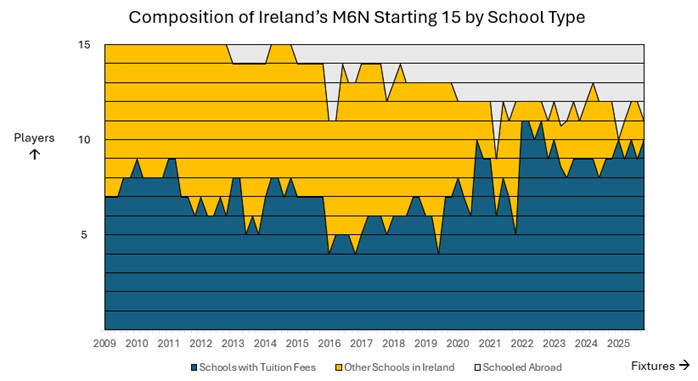
This blog is not to criticise the players who ably represent Ireland in elite level international competition. Nor do I offering any proposals for increasing the representativeness of the men’s national team. It should be noted that Ireland’s national team, while getting more exclusive, is becoming increasingly successful. There is an irony that at a time while Ireland’s sponsors market the team under the slogan #TeamOfUs, the pathways into that team are may actually be getting more restrictive. Getting back into a rugby school after getting expelled from it is one thing, getting into one that charges thousands of euros in tuition fees is entirely another.
This blog is written as a personal opinion piece and is not endorsed by the Department of Physical Education and Sport Sciences, or the University of Limerick.
Kevin Volf is a Postdoc in the Department of Physical Education & Sport Sciences, UL.
Contact: Email kevin.volf@ul.ie Follow on X @kevin_volf ORCID Bluesky LinkedIn ResearchGate
 PESS News & Information