

In Gaelic football, where players use both hands and feet to execute skills, the ability to perform actions on both sides of the body is seen as advantageous. This ability, known as bilaterality, is often assumed to be binary: left or right-sided. However, our research, along with a growing body of work, suggests that the reality is far more complex.
The term laterality refers to the preference most people have for using one side of their body in motor tasks, typically seen as “right-handed” or “left-footed.” Most people are consistently unilateral, meaning we rely on the same side across most tasks (Papadatou-Pastou et al., 2020). However, some individuals are bilateral, using both sides equally, while others are mixed-lateral, showing different preferences depending on the task, for example kicking with the right foot but passing with the left hand (Díaz-Pereira et al., 2023). A particular case of this is crossed laterality, where a person’s preferred hand and foot are on opposite sides, such as being right-handed but left-footed (Ferrero et al., 2017).
Building on the work of Dillon et al. (2024), we re-analysed video footage from 121 elite Gaelic football matches to investigate how high-performance male and female players use their limbs across four key skills: the hop, solo, hand pass, and kick pass. The aim was to classify players’ laterality profiles across multiple actions, and to examine whether gender influenced these profiles. We also wanted to assess whether right-sided players were more strongly lateralised than left-sided players.
Each player was categorised as right-sided, left-sided, or bilateral for each individual skill. These skill-specific classifications were then used to build an overall laterality profile for each player. These profiles weren’t limited to basic labels, but instead included consistent unilateral, consistent bilateral, partial bilateral, mixed-lateral, crossed-lateral, and partial crossed-lateral profiles.
The majority of players were unilateral, most often right-sided, and no player was found to be consistently bilateral across all four skills. However, to underline the complex nature of laterality, Figure 1 shows the array of categories each player can fall into for passing (hand pass and kick pass) skills alone; not to mention carrying (hop, solo), foot (kick pass and shots), and hand skills (hand pass and hop). Bilateral referred to players who were bilateral in both skills, while partial bilateral described those who were bilateral in just one skill. Crossed lateral players used opposite limbs; for example, the left leg and right hand, or the right leg and left hand. In contrast, unilateral left and unilateral right indicated players who consistently used both the hand and leg on the same side of the body.
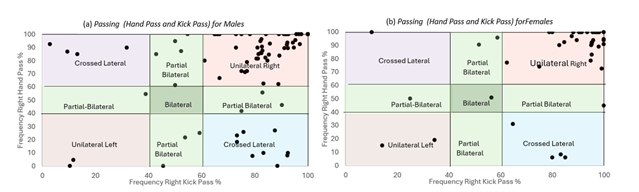
Figure 1: Laterality profiles for (a) passing skills for male, (b) passing skills for female Note: Each dot represents at least one participant (dots may overlap).
Left-handed and left-footed players were relatively less reliant on the dominant limb, in each of the skills analysed, than right-side dominant players; albeit most players were still markedly biased towards one limb. The increased bilaterality amongst left-side dominant individuals is consistent with a number of non-sporting studies (Bondi et al., 2020; Bryden, 2016; Buckingham et al., 2009; Peters 1989; Johnstone et al. 2021; Judge & Stirling 2003) who have found that left-handers have smaller asymmetries, or are more inclined to use their non-dominant hand, in skills involving their hands than right-handers. However, within Gaelic football the increased levels of bilaterality seen in left-sided players is not widely known amongst coaches and players (Dillon et al., 2024). Differences in the physical structure of the brain has been postulated as a reason why left sided individuals are less lateralised than their right-sided counterparts. More specifically, the corpus callosum is frequently seen as a key cerebral factor influencing lateralisation. The corpus collosum is the main fibre tract connecting the right and the left cerebral hemisphere and has more than 350 million fibres (Westerhausen et al., 2004).
Why all this matters
Coaches, performance analysts, and applied sports scientists in Gaelic football, as well as in sports like rugby, soccer, basketball, Australian Rules football, and American football, need to recognise the full range of laterality profiles their players might show. A more detailed understanding of each player’s laterality could improve individual skill development, shape feedback strategies, and even influence how opposition players are analysed. In sports where hands and feet interact during play, such as in kicking, punting, and passing under pressure, it becomes especially important to assess laterality for each limb, rather than treating the body as a single, dominant unit.
Additionally, the minimal gender differences observed in our findings suggest that strategies around laterality development should be applied equally to male and female players. Coaches should also be aware of the potential for left-sided players to be more flexible in developing non-dominant skills. This awareness could inform training priorities, as well as the pace and type of development expected from left- versus right-dominant athletes.
Karol Dillon is a postgraduate researcher in the Department of Physical Education and Sport Sciences, University of Limerick.
Contact: Email: karol.dillon@ul.ie @KarolDillon8 ResearchGate
 PESS News & Information