

Writing a research project is often a novel step for many coaches on the programme. This is especially true considering that typically half of the cohort are coming in via Recognition of Prior Learning; that is, they do not have an undergraduate degree in a related discipline, but rather are drawing upon their abundance of learning from their previous coaching experiences. If the idea of writing as a means of improving your coaching makes you pause, have a read of how the coaches on the programme describe the process:
“I found that I learned a lot about my coaching in the last couple of weeks typing, because you know, you get time to reflect on everything and it’s a very interesting process. I actually found you’re learning within the writing”
“How nice it is to feel change occur and see the development. Would I have noticed this change if I wasn’t doing the MSc project? Or would I have been so rigorous and held the mirror up to myself so closely, particularly when it was uncomfortable if I wasn’t doing it as part of a formal University course? Forcing myself to write, reflect, talk with peers and mentors, and use Personal Development Plan and action I vital in enabling these changes. I had been reading about it for years but didn’t change my behaviour.”
As an applied programme, it is particularly pleasing to read coaches describe how:
“The main findings will undoubtedly inform and positively influence my coaching practice in the new training season and have already translated successfully into my role as coach developer in training”
Where can I read more about the programme?
A course overview is available here, or you can take a look at #MScAppliedSportsCoachingUL where you will find insights such as exemplar pre-course activities and examples of the type of research we will be engaging with. You can also explore these FAQs.
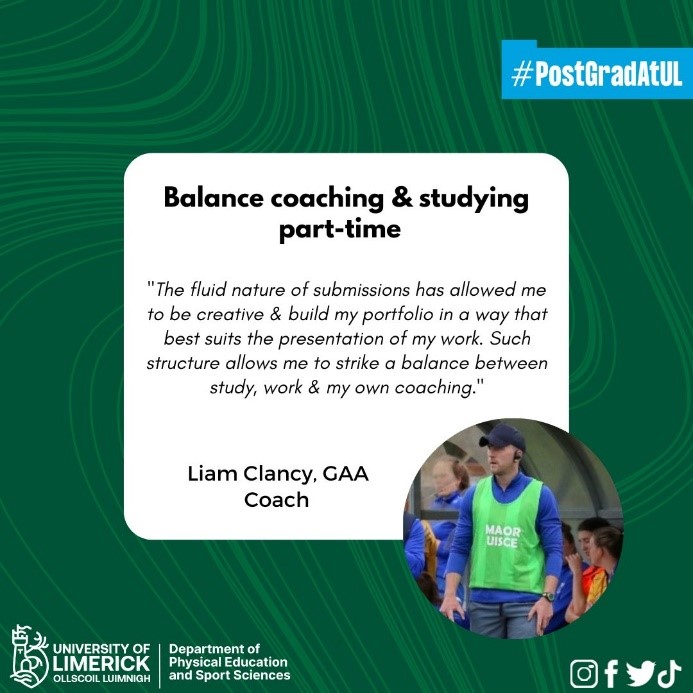
The student perspective:

What kind of topics do coaches research?
Coaches have researched a wide range of topics. For some, they have conducted action research which means they are both the researcher and the participant in the research as they work to improve some aspect of their practice. For others, they are interested in learning more about some coaching topic (e.g., half-time team talks, developing skill through a games based approach) or running applied workshops (e.g., helping coaches to engage in more effective self-care; helping coaches become better at developing the individual within a team sport context). You can see some examples of recent projects and the research that inspired those projects in the table below.
| Project Concept | Guiding Research |
| ‘I lived the dream’ – athletes on performance pathways were asked to ‘project forward’ to the end of a successful career and tell their tale of how their career unfolded. This tale will be analysed to provide an insight into the athletes’ understanding of what faces them, identifying areas of knowledge and lack of knowledge which may be of use to the athletes and their coaches. To date, research in this area has mainly being retrospective; there is little pertaining to young athletes’ perceptions of their future pathway. | Mortensen, J., Henriksen, K., & Stelter, R. (2013). Tales from the Future: A Narrative Investigation of the Imagined Career Paths of Young Athletes. Sport Science Review, 22. [Link] |
| An investigation into half time team talks in elite rugby union: What is said and why, and who remembers what? This study combined observations and interviews to evaluate the purpose, content, nature and perceived efficacy of half-time team talks in high-performance rugby union via the exploration of the lived experiences of elite rugby union coaches and players. In particular, the focus was on whether half time communications aligned with players’ needs during half times. | Smith, B., & Sherwin, I. (2022). Coach and athlete perceptions of half-times in high-performance rugby union. Sports Coaching Review, 1-23. [Link] |
| Do coaches fill their own cups? A review of GAA talent academy coaches and how they address their own self-care needs. A workshop was conducted with a group of coaches to help them reflect upon and develop their self-care practices. | McCullogh, E., & Safai, P. (2023). Self-care as self-preservation: where is the support for coaches’ self-care in Canadian sport?. Frontiers in Sports and Active Living, 5, 1278093. [Link] |
| Player Development Coaching (PDC) – Coaching the Individual in a Group Setting. Initially, a group of coaches with a reputation for coaching the individual within a team sport setting were interviewed. From these interviews, a series of principles were established. Guided by the idea that teaching is an excellent way of learning, these principles were presented to a group of club coaches within a focus group, which doubled as a data collection on the coaches’ current practices. The club coaches then reflected on their coaching the individual within group settings for 8 weeks, before a final focus group consolidated their learning. | Bergmann, F., Wachsmuth, S., O’Connor, D., Larkin, P., Dugandzic, D., & Höner, O. (2024). Practice Design and Coaching to Support Learning in Elite Youth Soccer Players: Recommendations From International Coaches, Coach Educators, and Researchers. International Sport Coaching Journal, Ahead of print. [Link] |
| Developing skill within the context of a Games-Based Approach – interviewing a panel of intercounty Gaelic football coaches to establish how they bring skill development to life in their use of a Games Based Approach. | Otte, F. W., Millar, S. K., & Klatt, S. (2020). How does the modern football goalkeeper train?–An exploration of expert goalkeeper coaches’ skill training approaches. Journal of Sports Sciences, 38(11-12), 1465-1473. [Link] |
| How I became a more player-centred coach: Gavin describes and reflects upon his journey to understand what player-centred coaching involves, and how he can be more player centred in his practice. | Evans, J. R., & Light, R. L. (2008). Coach development through collaborative action research: A rugby coach’s implementation of game sense pedagogy. Asian Journal of Exercise & Sports Science, 5(1), 31-37. [Link] |
| An audit of one club’s successful implementation of the Ladies’ Gaelic Football Association’s Gaelic4Teens Program to retain teenage girls, drawing upon multiple sources of information to provide guidance to other clubs on how to best implement this programme. | Farmer, O., Duffy, D., Cahill, K., Lester, D., Belton, S., & O’Brien, W. (2018). Enhancing the evidence base for Irish female youth participation in physical activity—The development of the Gaelic4Girls program. Women in Sport and Physical Activity Journal, 26(2), 111-123. [Link][Presentation] |
What is the deadline for applications?
The deadline for late applications for the September 2025 start is July 29th, subject to places remaining on the programme.
If you are interested in the programme or require further information please contact:
Dr Philip Kearney PhD
Course Director – MSc Applied Sports Coaching
Department of Physical Education and Sport Sciences
University of Limerick
Limerick.
Ireland Tel: 00-353-61202844
Email: ASC@ul.ie
Dr Phil Kearney is the Course Director of the MSc Applied Sports Coaching within the PESS Department here at the University of Limerick. View Phil’s profile: https://www.ul.ie/pess/iframe-staff/dr-philip-kearney

 PESS News & Information