
How often does high-quality research make its way into policy? More rarely than we like to think. For this reason, researchers and policymakers around the world have frequently described a research-policy gap. An example is the former Canadian Member of Parliament Keith Martin who stated that „our central challenge is (…) not a knowledge gap but a translation deficit“ (The Lancet). In this blog article, I will reflect on the importance of knowledge translation based on my personal experience in the last few months.
Why Knowledge Exchange Matters
Knowledge exchange refers to the process of connecting research with other organisations to drive impactful innovation (link). I learned a lot about the importance of knowledge exchange in my current position, as Marie Skłodowska-Curie Actions (MSCA) Postdoctoral Fellowships emphasize not only scientific outputs but also societal impact. Consequently, translating research for non-academic audiences played an important role in my fellowship application. As my research focuses on physical activity policy, I particularly see the importance of contributing to evidence-informed policymaking – and increasing the policy relevance of my research – by exchanging knowledge with government officials and non-governmental organisations.
My experience in 2026
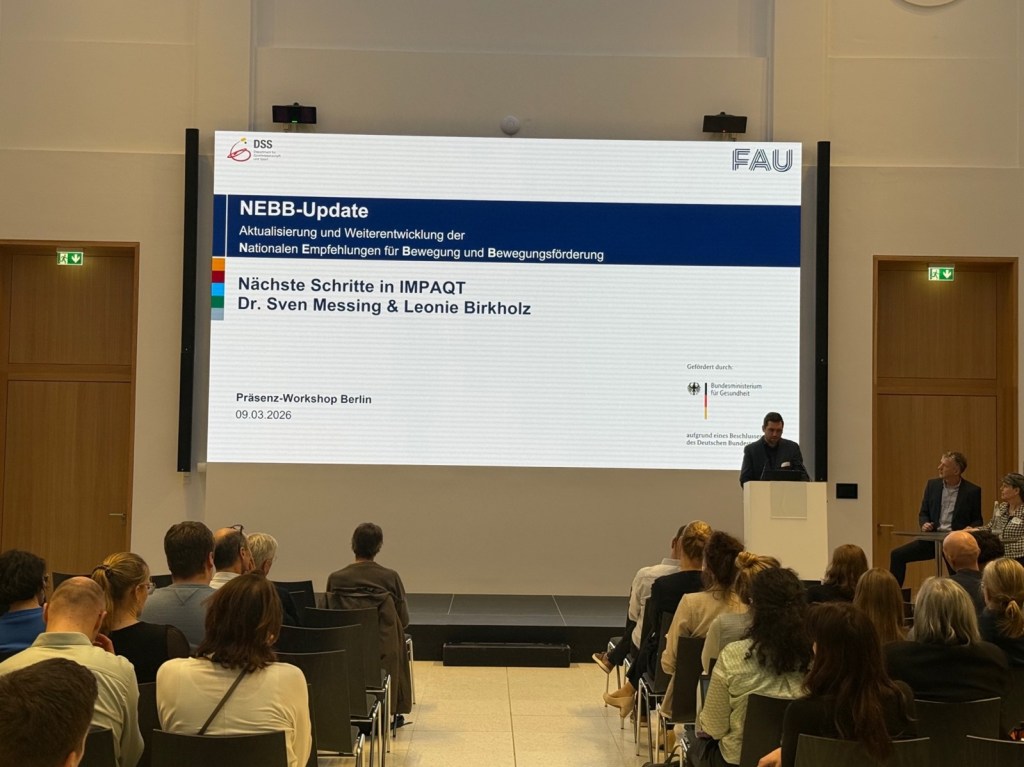
Since the beginning of the year, I have been involved in several knowledge exchange activities. My personal highlight was to chair an online workshop which brought together 95 researchers, practitioners, and policymakers to co-create policy recommendations based on findings of the IMPAQT project. Together with Prof Catherine Woods and Dr Kevin Volf, I also facilitated an in-person workshop with policymakers in Dublin. And in the German context I had the chance to share my research with a committee representing all 16 state-level sport ministries, and to help facilitating another workshop with 120 stakeholders. Across all these settings, I observed that discussions often combined different perspectives – the scientific evidence but also the real-world experience of policymakers and practitioners. As knowledge exchange is not one-directional, it is important to view such opportunities not as another means of disseminating research findings, but as an opportunity for dialogue with policy and practice.
Engaging the media
Another related aspect is the public communication of research. Due to the high media interest related to the publication of the Nature Portfolio Physical Activity Series (link), I had the opportunity to provide expert statements to German journalists. The aim of these statements was to interpret the international publications from a national perspective. I was delighted to see my statements being cited by national media outlets such as the Frankfurter Allgemeine Zeitung (link, 818,000 daily readers), the Tagesspiegel (link, 394,000 daily readers), and a magazine for pharmacists (link, 60,880 readers per issue). Journalists were particularly interested in citing complementary findings from German studies and actionable recommendations for promoting physical activity.
A Call to Action
I acknowledge that these knowledge exchange activities may be perceived as onerous and that the high workload associated with many scientific projects may prevent researchers from dedicating time to it. And I am aware of my privileged position to have a fellowship in which the translation of research findings into policy was part of my grant proposal. However, my key takeaway from these activities is: If we want our research to matter in the real world, we must invest resources in knowledge exchange. Evidence alone does not create change – people do, and this requires dialogue.
Sven Messing is a is a Marie Curie Research Fellow at the Physical Activity for Health Research Centre, HRI, PESS. His work focuses on physical activity policy.
Contact: Email sven.messing@ul.ie. Follow on twitter: @SvenMessing. Researchgate, ORCID, Linked-In

 PESS News & Information