
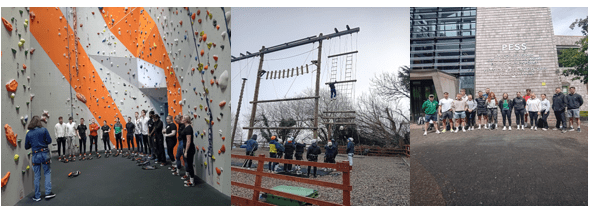
This year, the PESS Department delivered three NFQ Level 8 Physical Education (PE) micro-credentials (MC) in Adventure Education and Water Based Activities with Pedagogy, Competitive Team and Individual Based Activities, and Aesthetic and Expressive Activities.
The MC are targeted towards students/individuals who need to complete the required areas of study for registering as a PE teacher with the Teaching Council in Ireland or who are wishing to undertake the Professional Masters in Physical Education at UL. I am delighted to say that a total of 50 students from all over Ireland have engaged with the programmes this year. A diverse mix of students and professional from a variety of background including sports science, post-graduate studies and teaching have completed respective modules. This blog will discuss how the MC are taught, delivered and where to apply for next year.
How are MC delivered?
The MC are delivered through a blended learning approach of evening online lectures and a four-day intensive practical week taught in UL. Lectures are held once a week in the evening to accommodate college/work commitments and focus on teaching students the underpinning theories. This theory is them applied in a professional learning environment practical week, where students are taught the pedagogical knowledge and technical/digital skills to teach young people. Students will be afforded numerous opportunities to peer teach, design lessons, practice skill and receive instant feedback from teacher educators on their development. There are two assessments attached with each of the MC modules and are both pass/fail. The first assessment is an online quiz aligned with the lecture content and the second is a peer teaching episode held on the final day of the practical week.
PY4183 Adventure Education and Water Based Activities with Pedagogy
The Adventure Education module lectures begin in mid-November and practical week is help at the beginning of January. Experiential Learning is at the core of teaching Adventure Ed and the module is designed to teach students how to provide learners with opportunities to challenge themselves, solve problems, work as a team, overcome risks and trust in themselves and peers. Therefore, Adventure Ed is taught as a philosophy as much as a set of activities and students are taught instructional strategies and teaching methodologies that encourage holistic approaches to learning. Topic areas covered include camp craft, orienteering, hill walking, rock climbing (UL climbing wall), team challenges and a full day at Killaloe Adventure Centre. The second part of the module consists of Water-Based activities. Here students will have access to the UL Arena swimming facility to learn the fundamentals of swimming strokes, aqua aerobics, water competence and safety at a depth safe for all abilities.
PY4213 Competitive Teams and Individual Based Activities
Competitive Teams module lectures and the practical teaching week is taught during May and June. The lectures cover the theoretical aspects of the module such as nonlinear pedagogies to teaching games, curriculum models, principles of play (attack & defence), Junior and Senior Cycle Frameworks and lesson design. The practical element of the module covers a variety of invasion games like hockey, handball and basketball. Net and court games, badminton and volleyball and striking and fielding games such as cricket and rounders. Students on the module are taught how to implement a more nonlinear approach to teaching by placing the learner in the context of the game as much as possible. Demonstrating the importance of how game design and questioning can scaffold learning rather than teaching traditional repetitive movements and using games as rewards. The curriculum model, Teaching Games for Understanding (TGfU) helps frame the learning during the practical sessions, where students are co-creators in designing learning activities to promote meaningful enjoyable lessons.
PY4173 Aesthetic and Expressive Activities
The content of the module is designed to support students with breadth and depth of knowledge and how to teach dance and gymnastics in a secondary school environment. Over the 6 weeks students participated in wide variety of activities both online and in-person session, here is an overview of the module content:
Week 1: Introduction to aesthetic and expressive activities and how to teach these concepts through dance and gymnastics. The power of curriculum models and how they can enhance the students learning through guided discovery.
Week 2: Is the face-to-face week where students attend four full days of practical experiences of dance and gymnastics. Students learn how to apply teaching strategies, apply curriculum models and digital technology in the PE hall supported with robust pedagogies of learning.
Week 3-6: These next three weeks are back online for students to finish the module. This lecture series seeks a deeper understanding of aesthetic and expressive activities in the school context. Students will cover, how to design a meaningful curriculum, school syllabi changes, digital technology, literacy/numeracy and how to implement holistic aesthetic and expressive lessons.
Final words
If you are interested in applying for the next round of MC expressions of interest are now open for the second instalment, please click the link here to find out more. More on upcoming PESS events will be posted on our Instagram and LinkedIn profiles.
A big thank you to the rest of the PESS team behind the MC modules, Ursula Freyne, Prof Elaine Murtagh, Brigitte Moody and Jack Hickey.
Harry Fleming is a PhD researcher and a micro-cred coordinator.
 PESS News & Information