
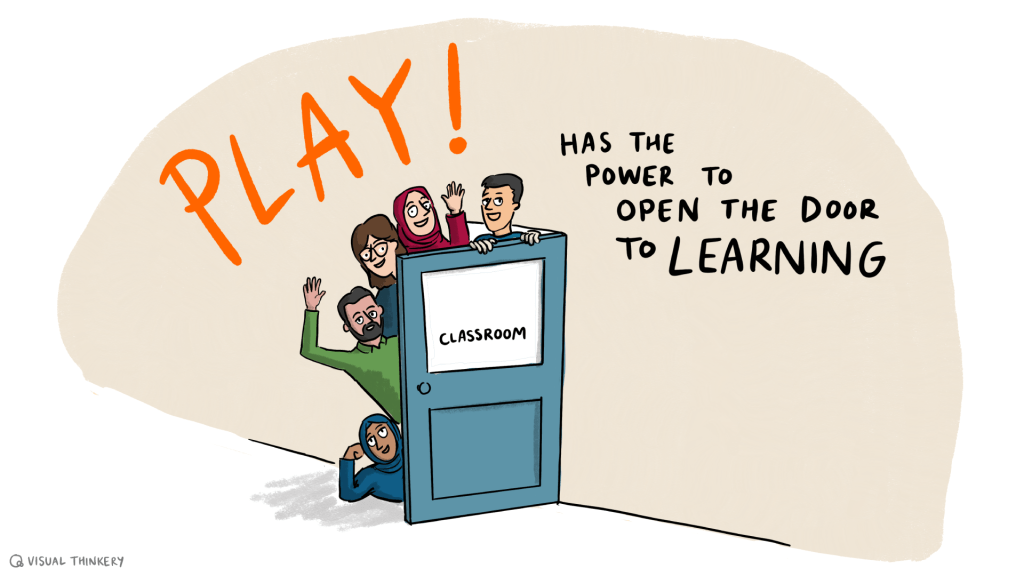
The recently published article in The Teacher Educator represents the latest peer reviewed output from the four-year Learning in Motion project, an ambitious international programme funded by Research Ireland through the COALESCE scheme. Read alongside the project’s final report, the paper offers a timely contribution to debates about how learning, teaching and professional development can be reimagined through movement centred and embodied pedagogies.
At its core, Learning in Motion sought to understand how movement-based approaches to learning can be meaningfully embedded within education systems, teacher education and everyday classroom practice. Working across national and cultural contexts, the project brought together researchers, teacher educators and practitioners to explore not just whether movement matters for learning, but how it is understood, enacted and sustained in real educational settings. A defining feature of the project was its partnership with Birzeit University, Palestine, alongside collaboration with the NGO Right To Play, whose work on play, inclusion and child wellbeing strongly informed the project.
A focus on preservice teachers
The latest article turns particular attention to preservice teachers and their school placement experiences, highlighting the central role student teachers play in translating movement-centred ideas into practice. Specifically, the study examines how preservice teachers in Palestine enact play-based learning (PBL) and gender-responsive pedagogies (GRP) during school placement – an area rarely explored in depth, particularly in contexts shaped by conflict and instability.
Teaching and learning in a highly constrained context
The study is situated within the very challenging conditions in which Palestinian universities, schools and communities operate. Students and educators in the West Bank face daily mobility restrictions, checkpoints, resulting in delays and harassment by Israeli soldiers and settlers. Over decades of ongoing war and emergency, the Palestinian education system has been required to function under extreme pressure.
Within this context, approaches such as PBL and GRP take on added significance. Integrating playful, inclusive and movement-based pedagogies within teacher education offers potential to support children’s wellbeing, rebuild a sense of safety, and encourage inclusive participation in classrooms affected by trauma and disruption.
What the study found
Using interviews and classroom observations with 17 preservice teachers across four Palestinian universities, the study explored practicum experiences through the COM‑B model (Michie et al, 2011), which frames behaviour as shaped by capability, opportunity and motivation.
Preservice teachers demonstrated strong motivation and confidence in using play-based learning. They recognised play as a powerful way to engage learners and support positive classroom relationships. However, opportunities to implement PBL were strongly shaped by physical classroom conditions and, critically, by the guidance and modelling provided by teacher educators. Where teacher educators actively modelled play-based approaches, preservice teachers felt better equipped to translate theory into practice.
Engagement with gender-responsive pedagogies was more limited. Although some equitable practices were observed, preservice teachers often lacked a clear understanding of GRP and were uncertain about how to apply it meaningfully. Structural factors such as large class sizes, uneven gender distributions, and limited opportunities for explicit modelling meant that greater support is needed to strengthen GRP within teacher education programmes.
Implications for teacher education
The findings reinforce a central message of the Learning in Motion project and its final report: teacher educators matter. What is prioritised, modelled and critically examined within teacher education programmes strongly shapes what preservice teachers feel capable of enacting in schools.
While play-based learning shows clear promise, targeted professional development is needed to support teacher educators and preservice teachers in engaging more confidently with gender-responsive pedagogies. Strengthening this work is essential if inclusive, movement-based approaches are to support learning and wellbeing for all children.
As the publication phase of Learning in Motion continues, this article serves as a reminder that movement-centred pedagogies are not quick fixes. Rather, they invite us to rethink how learning is understood, and to create professional spaces where teachers are supported to explore, experiment and reflect, especially within contexts of ongoing adversity.
Hamed, G., Murtagh, E. M., Aljanazrah, A., Khalil, N., & Walsh, A. (2026). Understanding Preservice Teachers’ Practices of Embedding Play-Based Learning and Gender-Responsive Pedagogies During Practicum. The Teacher Educator, 1–28. https://doi.org/10.1080/08878730.2026.2651949
Prof. Elaine Murtagh is a member of the Sport Pedagogy and Physical Activity for Health research groups.
Elaine.Murtagh@ul.ie ORCID ResearchGate LinkedIn

Discover more from PESS News & Information
Subscribe to get the latest posts sent to your email.
