
My name is Sarah Willis, and I recently graduated from the BSc Sports and Exercise Science programme at the University of Limerick.
During my final year, I completed a PESS internship with the Irish Rugby Injury Surveillance (IRIS) research group. What began as an internship placement focused on injury surveillance and data analysis became a career-defining opportunity, as I now work as a Medical Co-ordinator in the IRFU medical department.
After completing my third-year co-operative placement with the Irish Women’s Hockey team and Danu Sports, I became interested in pursuing an opportunity in injury surveillance. Working previously alongside high-performance athletes at the Sport Ireland Institute and closely with the women’s hockey team gave me valuable insight into the injuries that athletes experience in elite sport. Other previous work with Danu, including virtual support for hospital patients and motion capture analysis for lower-limb discrepancies, further developed my interest in applying my sport science and technology knowledge in a practical setting. Alongside my academic studies in Sports and Exercise Science, this led me to apply for a PESS internship and pursue a pathway focused on non-contact injuries in rugby.
My internship focused on injury surveillance in Irish amateur rugby, with particular attention to Schoolboy Senior Cup and men’s amateur club data from the 2017–2025 seasons. The project aimed to identify patterns and risk factors associated with non-contact injuries and to support the development of evidence-based injury prevention strategies for the IRFU.
Working on the IRIS Project
A large part of my role involved extracting and organising data from IRIS web and analysing it using Excel and Power BI. The IRIS web database included over 12,000 players and 579 unfortunate non-contact injuries across seven years, so attention to detail was essential. I worked with four separate files covering men’s senior club and Schoolboy Senior Cup match and training data, ensuring that the same key variables were retained across each dataset.
Using Power BI, I created interactive reports that allowed me to explore injury location, type, occurrence, position, severity, match incidence, temporal trends and also a focus on individual hamstring injury trends. This gave me a much clearer understanding of how data can be transformed into meaningful insights that are useful for reporting and decision-making.
I also grouped injury duration and severity into International Olympic Committee-aligned categories of slight (0-1 days), minimal (2-3 days), mild (4-7 days), moderate (8-28 days) and severe (>28 days), which made the data easier to compare with other international sporting injury surveillance research. The findings are used by IRIS to report non-contact injuries to the IRFU and are also contributing to a wider body of research through multiple papers and publications.
Key Findings
The main finding from my intern project was that hamstring and strain injuries were the most common non-contact injury type across both cohorts and exposure settings. This highlighted the importance of targeting preventable non-contact injuries, through evidence-based strength and conditioning strategies.
Another important takeaway was the need to protect player availability. In competitive team sports, keeping players healthy and available is central to performance, and surveillance data can help identify where prevention efforts should be focused.
The project also reinforced the importance of training design. By understanding when and where non-contact injuries are most likely to occur, coaches and practitioners can make more informed decisions around conditioning, load management and injury prevention.
My Key Learnings
This internship helped me develop a high level of competency in Power BI and gave me valuable experience working with a large, complex database. I also learned how to manage multiple important deadlines at once, balancing the internship with my final-year academic commitments.
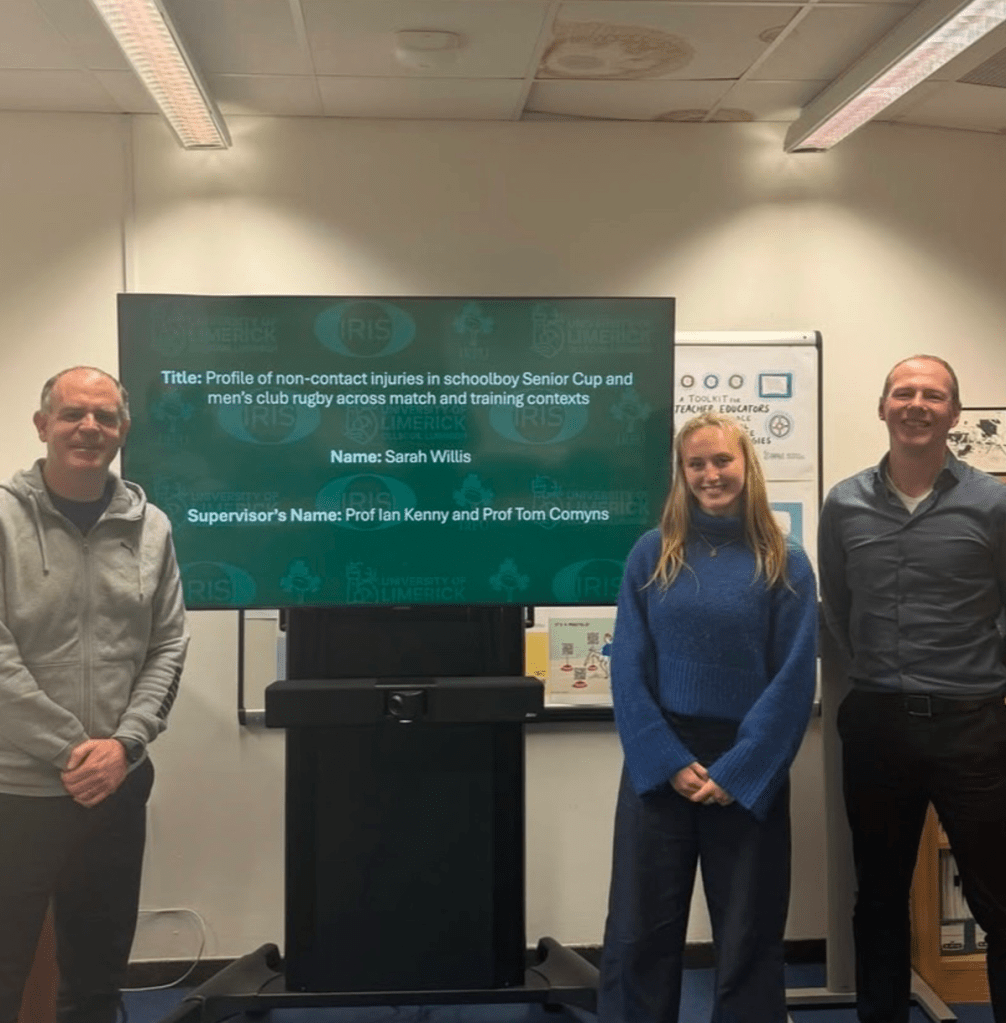
Regular biweekly meetings with my supervisors, Professor Ian Kenny and Professor Tom Comyns, reinforced the value of accountability, asking questions and taking initiative. Guidance on data processing was expertly provided also by Dr Kilian Bibby. These meetings helped me stay focused and supported me in delivering the project on time.
I also developed stronger project management skills through working independently and following a structured approach to keep the project moving forward.
Memorable Experiences
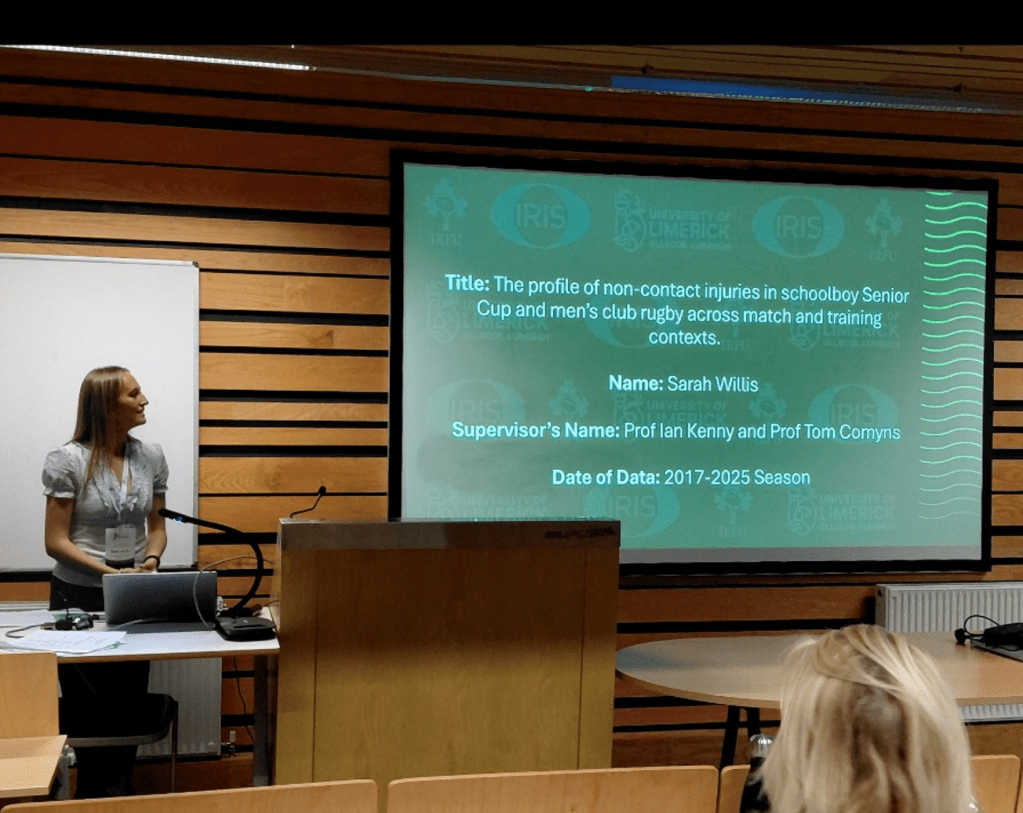
One of the most memorable parts of the internship was engaging with the wider sport science and medical community. Attending two Irish conferences through the Irish Sport and Exercise Science Association (ISESA), and the All-Ireland Conference of Undergraduate Research (AICUR) gave me valuable insight into how professional organisations share and interact with current and relevant research.
I was also asked to present at both conferences, which greatly improved my confidence in presenting and discussing ideas. These experiences were important in shaping my key learnings, as they allowed me to engage directly with my research and better understand how it is communicated to wider audiences.
I also valued attending IRIS journal club meetings, where I learned from postgraduate researchers and saw how research is critically discussed and translated into practice.
How the Internship Changed My Career
My work with IRIS created a direct pathway into the IRFU. I was fortunate to have been appointed as Medical Co-ordinator (part-time) in the IRFU medical department. This role has shown me how applied surveillance work can connect academic research, governing bodies, and front-line medical practice.
Attending two Irish conferences and participating in IRIS journal club meetings further strengthened my confidence in presenting research, engaging with new ideas, and contributing to professional discussion. These experiences helped me grow not only as a student researcher, but also as someone beginning a career in high-performance sport and medical support.
Final Reflection
Looking back, this internship has been one of the most valuable parts of my degree. It allowed me to apply what I had learned in PESS to a real-world research environment, while also opening doors to professional opportunities I may not otherwise have had.
For anyone considering applying for the PESS internship, I would strongly recommend it. Whatever your interests are, the internship offers a wide variety of valuable practical experience and the opportunity to develop into a more well-rounded graduate through working on a real project with a supportive supervisor.
This internship provided great preparation for my final-year project, as it gave me valuable experience of the research process and helped me develop the skills needed to plan, organise and complete a larger piece of work in fourth year.
I am very grateful to Professor Ian Kenny and Professor Tom Comyns for their time, continuous support and supervision and to the IRIS research group for the opportunity to contribute to such an important project. The experience has played a major role in shaping the next step in my career.
| Sarah Willis is a BSc Sports and Exercise Science graduate from the University of Limerick and currently works as a Medical Coordinator in the IRFU medical department. Her interests include injury surveillance, player welfare, and evidence-based practice in sport. Contact: Sarah.Willis@irfu.ie Follow on LinkedIn: www.linkedin.com/in/sarah-willis-14144828b |
Discover more from PESS News & Information
Subscribe to get the latest posts sent to your email.
