
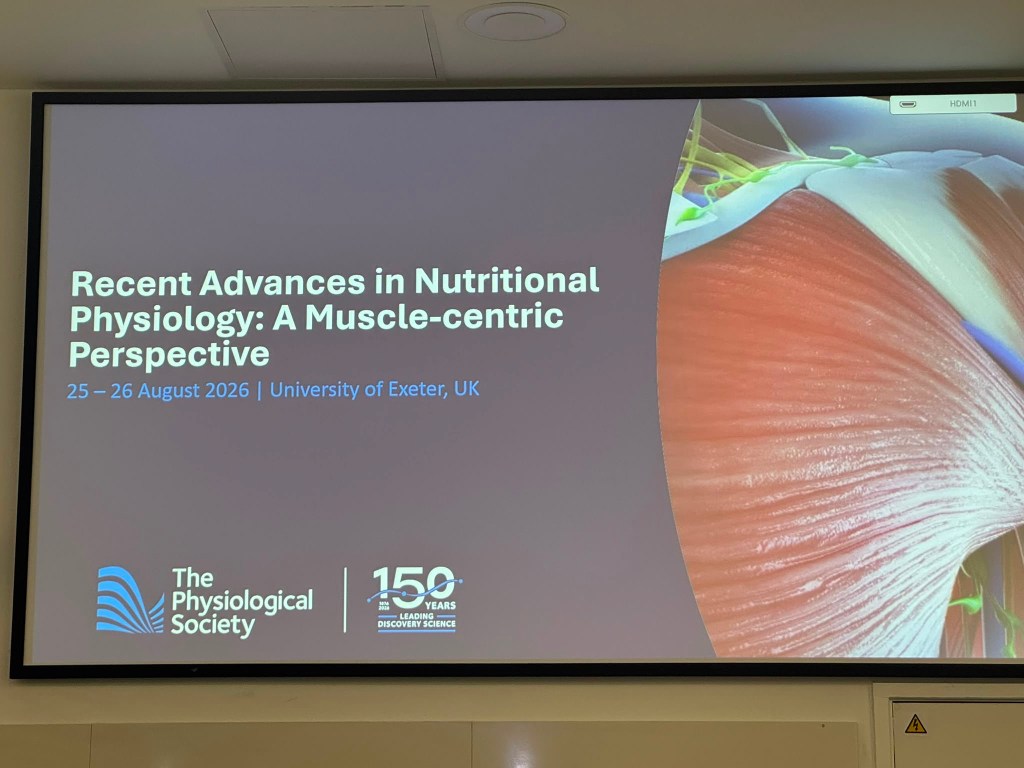
I recently attended The Physiological Society’s “Recent Advances in Nutritional Physiology: A Muscle centric Perspective” at the University of Exeter, UK, from 25–26 August 2026 as part of the Society’s 150th anniversary programme. The meeting, organised by Dr Marlou Dirks and Dr Alistair Monteyne, focused on skeletal muscle physiology, nutrition, and exercise interactions.
The programme provided an excellent overview of emerging research, spanning mechanistic studies through to clinical and applied nutrition, with clear relevance to sport and exercise nutrition.
Nutrition, Metabolism and Skeletal Muscle
A major theme was the increasingly complex relationship between nutrition, metabolism and skeletal muscle function.
The opening session focused on ketone metabolism, exploring the role of ketone bodies in skeletal muscle protein metabolism, the potential of exogenous ketones to influence carbohydrate metabolism and glycaemic control, and the broader metabolic consequences of nutritional ketosis.
These discussions highlighted that ketones should not simply be viewed as an alternative fuel, but as metabolic signals with potentially important effects on muscle and whole-body physiology.
A particular highlight for me was seeing my former PESS Postdoctoral Fellow Dr George Pavis presenting an incredible body of deep mechanistic work outlining the potential role for ketones in glycaemic control and how this might be achieved.
Nutrition, Metabolic Disease and Weight Loss
Another strong theme from the meeting was the role of nutrition in metabolic disease and during weight loss.
Presentations considered metabolic phenotyping in obesity, the gut microbiome and its implications for precision nutrition, and the potential role of high-protein diets in glycaemic control in people with type 2 diabetes.
The latter was presented by Dr Grainne Whelehan who undertook an internship under my supervision at PESS, and later as part of the Healthy Ageing and Performance Nutrition research programme as a research assistant.
Grainne has gone on to do outstanding work with real practical relevance and it is fantastic to see former PESS staff advancing their careers.
GLP-1 Therapies and Skeletal Muscle
We couldn’t have a nutrition and muscle focused meeting without exploring the hot topic of GLP-1 based therapies and skeletal muscle mass and function.
Prof Dan Cuthbetson outlined how some of the losses observed in muscle are to be expected, but we need more measures beyond DXA or BIA to understand the true impact on skeletal muscle and function.
For practitioners, this session emphasised an increasingly important consideration: improvements in metabolic health and body mass do not necessarily equate to preservation of skeletal muscle.
Understanding how dietary strategies and pharmacological interventions interact with muscle mass, function and quality will therefore become increasingly important.
Protein Metabolism and Amino Acid Availability
The meeting also provided an update on protein metabolism and amino acid availability.
Discussions ranged from plant protein digestibility and amino acid bioaccessibility, to a thought-provoking talk from Prof Luc van Loon asking “where does all the protein go?” to better understand bioavailability and the fate of amino acids.
Across the meeting there were also talks exploring the influences of sex and menstrual cycle, to protein requirements following bariatric surgery.
Together, these presentations reinforced the importance of considering not only total protein intake, but also protein quality, amino acid availability, feeding patterns and the physiological context in which protein is consumed.
Exercise and Nutrition Interactions
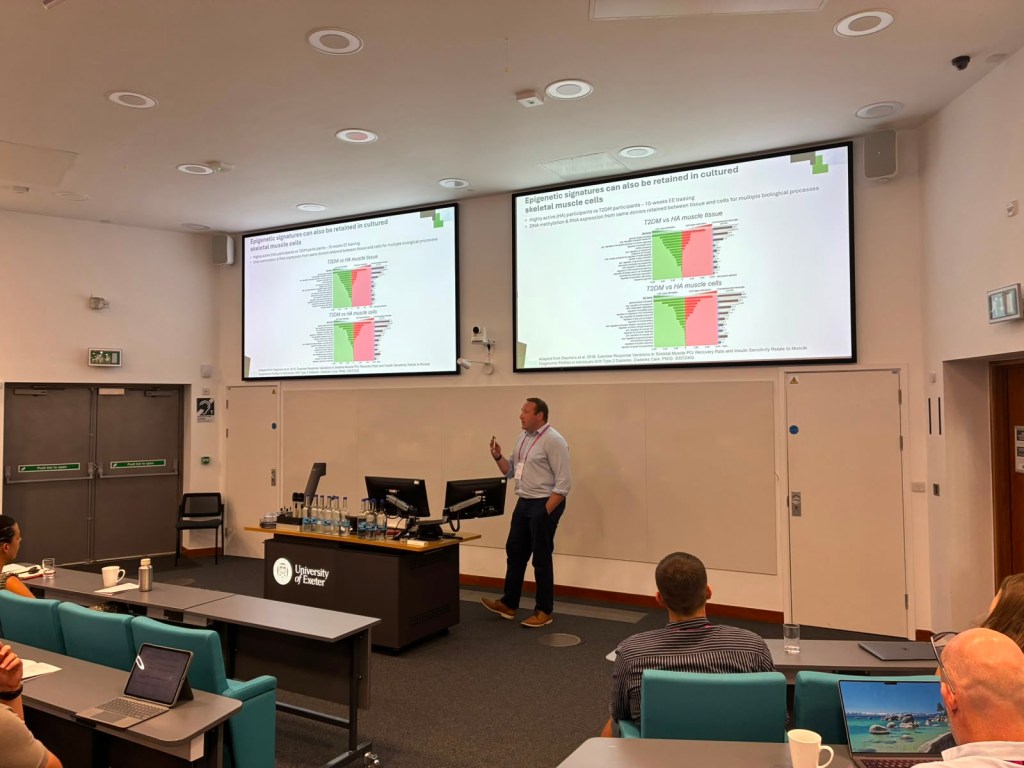
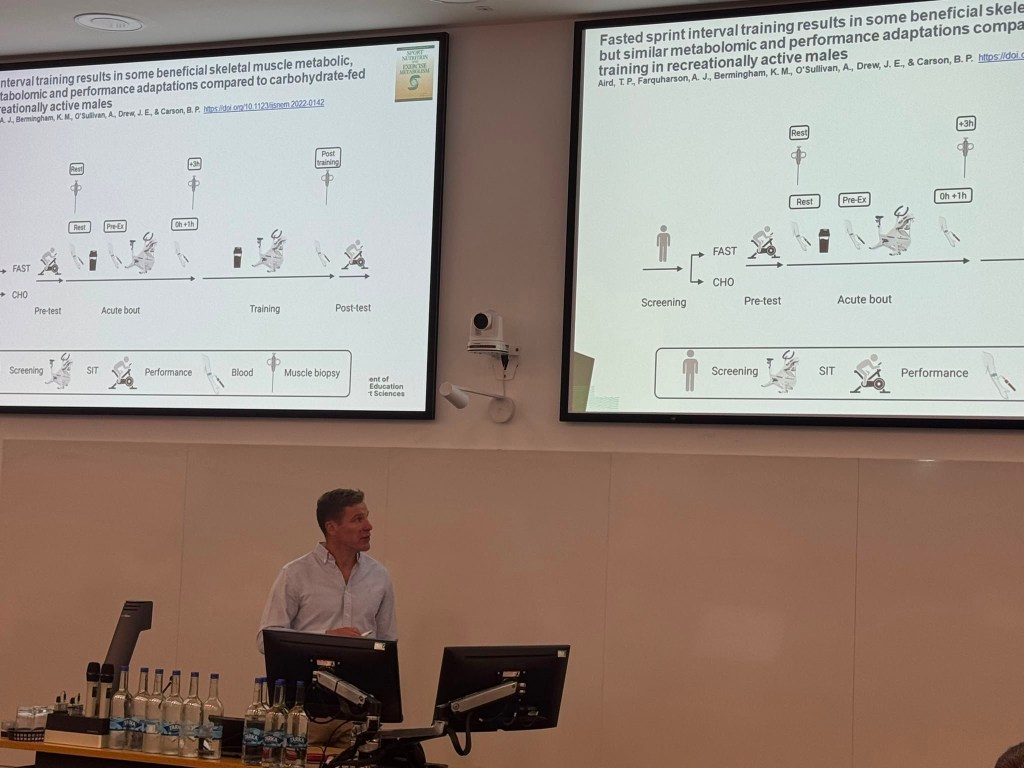
I attended the meeting primarily to contribute to the session on Exercise Nutrition Interactions, where I presented “Exercise and Nutrition as Co-Regulators of Skeletal Muscle Adaptation.”
The presentation explored how exercise and nutritional stimuli interact to regulate skeletal muscle remodelling and adaptation, emphasising the importance of considering these stimuli together rather than in isolation.
It was particularly valuable to place our work in the context of research spanning molecular mechanisms, nutritional interventions and applied exercise physiology.
I was also delighted that my colleague Dr John Noone presented in the same session on “Molecular and mitochondrial responses to exercise in human skeletal muscle myotubes.”
Together, the two presentations provided complementary perspectives on how exercise influences skeletal muscle at both the molecular and mitochondrial levels.
It was brilliant to have such a PESS presence at this international meeting.
Networking and Interdisciplinary Discussion
Beyond the formal presentations, one of the greatest benefits of the meeting was the opportunity for networking and interdisciplinary discussion.
Bringing together researchers from exercise physiology, food science, nutritional science, metabolism, clinical research and molecular biology created opportunities to consider familiar questions from very different perspectives.
Informal discussions around the presentations frequently extended beyond the immediate findings, exploring how mechanistic discoveries might translate into nutritional strategies for athletes, older adults and people living with metabolic disease.
The focused nature of the meeting and its size (approximately 60 people) made interactions with both the heavyweights of the field and the emerging talent very easy and the atmosphere was so open and welcoming.
Looking Ahead
Overall, the meeting provided a timely reminder that the future of nutritional physiology is increasingly muscle-centric, integrative and interdisciplinary.
For sport and exercise nutrition professionals, this evolving evidence base offers both exciting opportunities and important challenges as we move towards more personalised approaches to nutrition, exercise and the preservation and optimisation of skeletal muscle health.
Prof Brian Carson is a Professor of Exercise Physiology in the Department of Physical Education and Sport Sciences, University of Limerick.
Contact: Brian.Carson@ul.ie. Follow on twitter: @DrBPCarson. Research Profiles: ORCID https://orcid.org/0000-0001-8350-1481
Discover more from PESS News & Information
Subscribe to get the latest posts sent to your email.
